New whitepaper: How to Build on the Moon, with commentary from Niki Werkheiser, former NASA Director of Technology Maturation, shaped by conversations with the former ISS DirectorNew whitepaper: How to Build on the Moon, with commentary from Niki Werkheiser, former NASA Director of Technology Maturation, shaped by conversations with the former ISS DirectorNew whitepaper: How to Build on the Moon, with commentary from Niki Werkheiser, former NASA Director of Technology Maturation, shaped by conversations with the former ISS Director
Manifesto

Consciousness is the phenomenon worth building around.

Every room a human has ever occupied has shaped what that human became. We have never taken this seriously enough to design for it on purpose.

From the founder's own notes

"Life is the most important phenomenon that exists in the universe. Without life, the universe is meaningless. Meaning enters the universe with consciousness. Consciousness is the property of living things. Without living things, there's no meaning. Only one planet hosts intelligent civilization. Protect the island of meaning."

We believe the most important thing happening anywhere in the universe is that matter, arranged the right way, becomes aware of itself. Everything else, the propulsion, the payload mass, the pressure vessels, is in service of keeping that phenomenon alive somewhere it wasn't supposed to survive.

Space makes this impossible to ignore, because in space there is no atmosphere quietly doing the work of keeping you alive while you don't think about it. Every function the outside world used to perform invisibly has to be designed for on purpose, in the room. That is what we mean when we say a habitat is a second body wrapped around the first.
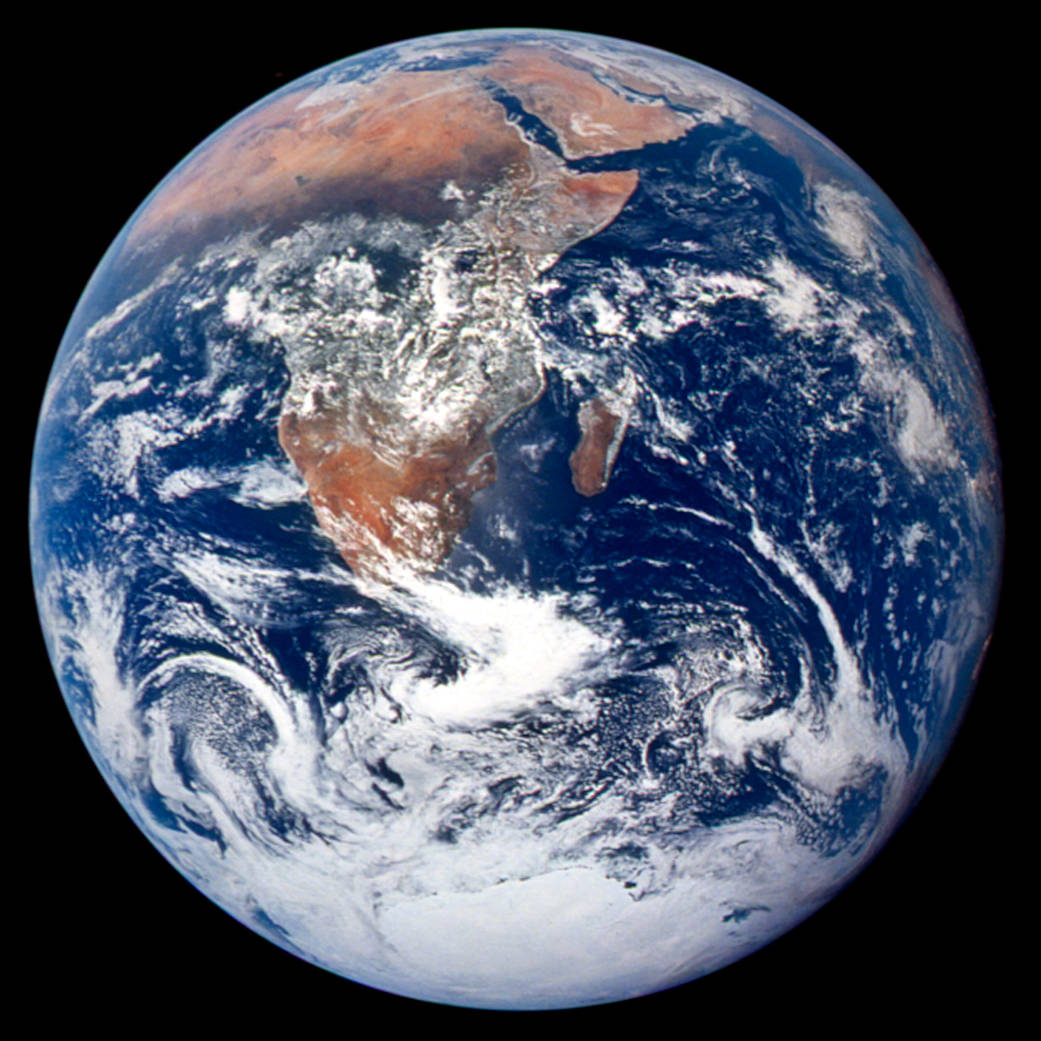
Earth as seen by the Apollo 17 crew, the Blue Marble photograph

Earth photographed by the Apollo 17 crew on their way to the Moon, 1972. The atmosphere that does all the invisible work. Credit: NASA.

We also believe consciousness does not end with the person who has it. It is carried forward, or it is lost, depending on whether anyone bothered to preserve it. A space architect who designed a habitat forty years ago and is now retiring is a library that can either be transcribed or allowed to close. We have already watched too many of these libraries close.

Our founder, Anastasia, grew up in Siberia, where survival and shelter were never abstractions. That shaped how she thinks about both, long before either became a professional discipline. At six years old, she decided what she wanted her work to be: making sure consciousness continues, treating the continuity of the human species itself as a gift worth building toward. That's not a metaphor we reach for. It's the actual, literal origin of why this manifesto exists, and it sits closer to existentialism than to engineering: the conviction that existence has to be actively chosen and built, not assumed.

01

The room is not neutral

A habitat does not merely contain a person. It participates in what that person becomes. Their sleep, their cognition, their sense of self. We design with this understood, not as a metaphor but as an engineering constraint.

02

Knowledge that isn't recorded is lost, not paused

The people who designed the first habitats are retiring. Their judgment does not get automatically inherited by whoever comes next. We treat their knowledge as a civilizational commons that requires deliberate stewardship, not something that survives on its own.

03

Commercial work funds the long view, it doesn't replace it

We take on paid engagements to stay solvent and stay close to what's actually being built. But the reason the Lab exists is the mid-TRL gap nobody else has an incentive to close, and the reason the Library exists is knowledge nobody else has an incentive to preserve.

04

Extreme environments are where design principles get honest

A house can be mediocre and its occupants will mostly survive it. A spacecraft, a submarine, an underground shelter cannot. That's not a special case. It's the condition that was always true of architecture, just visible now because there's nowhere left to hide it.

05

The next generation raised beyond Earth inherits our blueprints, not just our technology

If the environment shapes the body and mind inside it, then the habitats we design now are not just infrastructure. They are what the first off-world generations will be built from. We don't get to treat that lightly.

We are trying to keep the light of consciousness carried forward. In the people who fly, in the knowledge that gets preserved, and in the rooms we design well enough that no one has to think about them.

Follow the work