The Peristalsis Project: A Walking Martian Station
A modular mobile research base that moves across Mars the way a body moves: by peristalsis.
A station that moves
Stations with a permanent residence limit astronauts’ stay beyond their territory. Autonomous mobile modules however, can be a temporary station for arriving tourists and astronauts who want to explore further.
Its flexible design can accommodate a growing number of passengers, and each housing module is equipped with life support and other housing essentials. It owes its aerodynamic stability in Martian dust storms to its streamlined shape.
The moving structure can reach any point on the planet, and any block can be replaced with a new one if it breaks.
Biomorphic movement
Snake
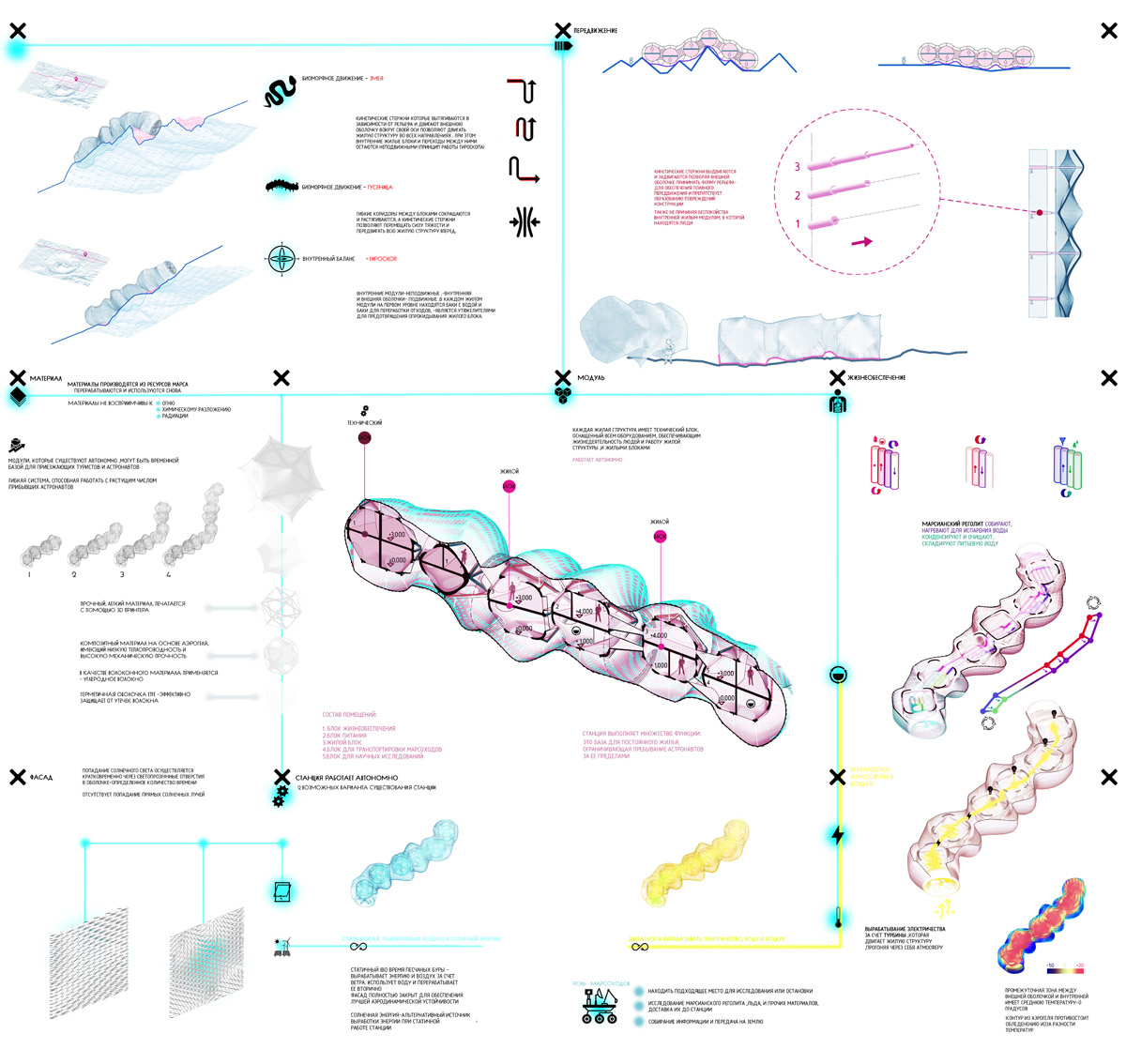
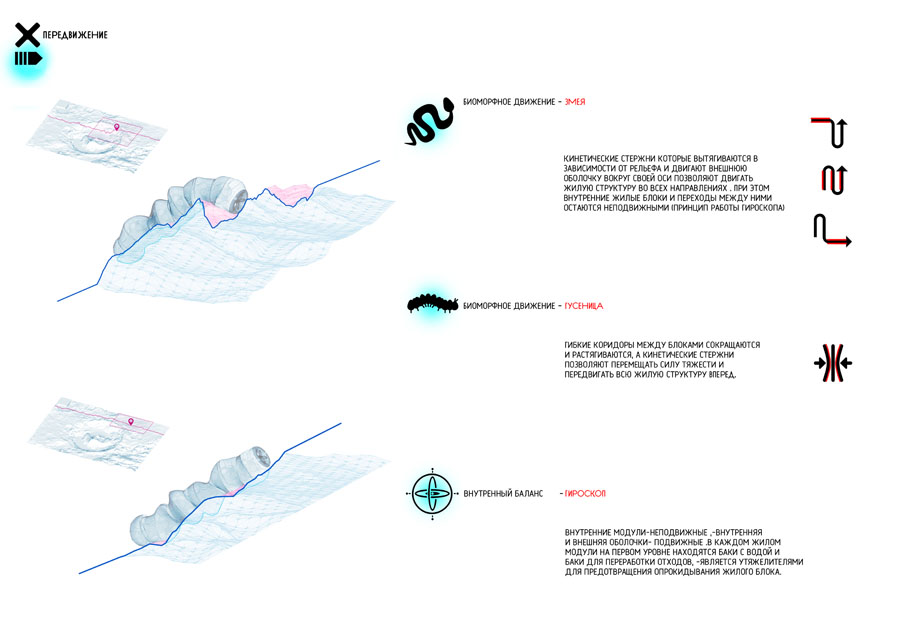
Kinetic rods stretch and contract to conform to the terrain below and move the outer shell in a peristalsis fashion across the Martian landscape. The housing modules and corridors between them remain level and stable respectively by behaving as a gimbal.
Track
Flexible corridors between units can shrink and stretch, in a peristalsis motion, while kinetic rods shift the center of gravity, allowing the mobile station to navigate Mars’ diverse terrain.
Internal balance, gyroscope
The inner modules stay fixed while the outer shell moves around its own axis. On the first level of each housing module sit the water tanks and the waste processing tanks, whose weight keeps the block from tipping over.
Modules
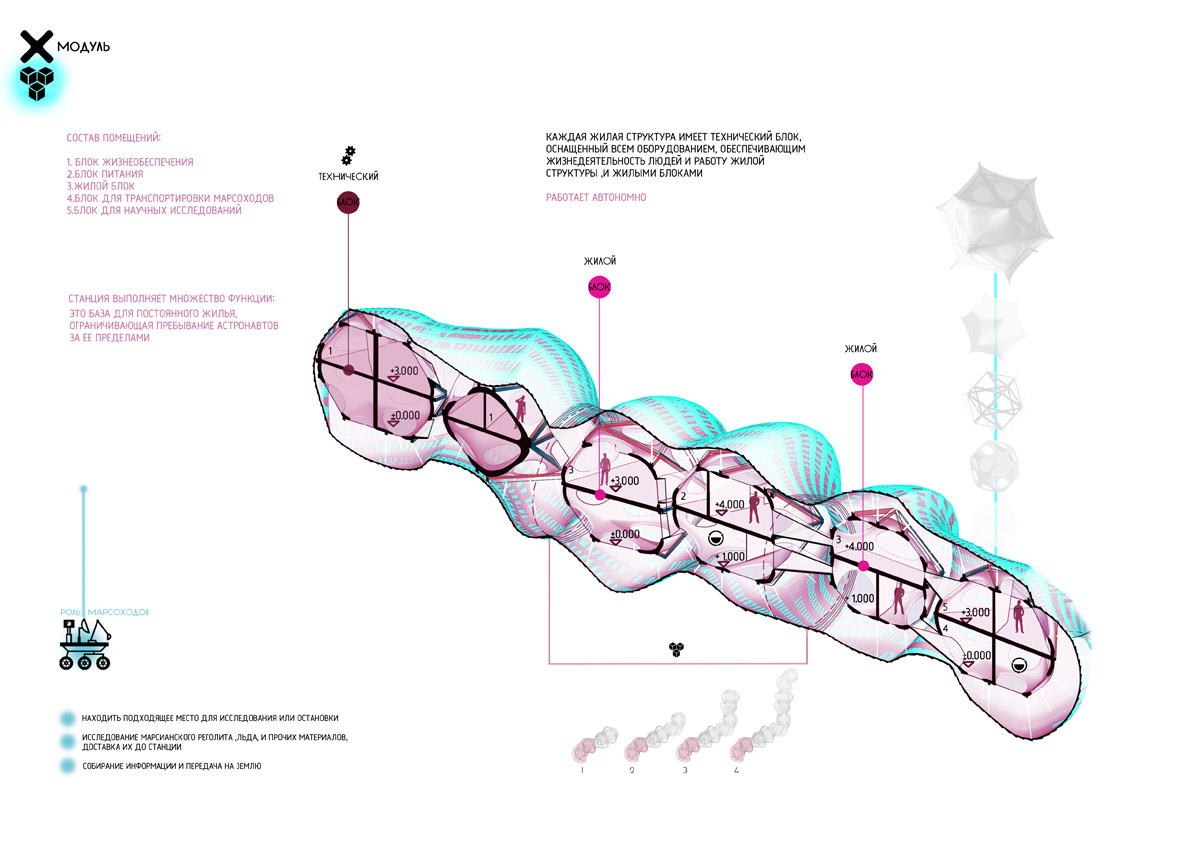
Each housing structure has a technical block equipped with everything needed to support the crew and run the structure, and it works autonomously.
Rooms
1. Life support block. 2. Food block. 3. Housing block. 4. Block for transporting rovers. 5. Block for scientific research.
The role of the rovers
Finding a suitable place to study or stop; studying Martian regolith, ice and other materials and delivering them to the station; collecting information and transmitting it to Earth.
Materials and facade
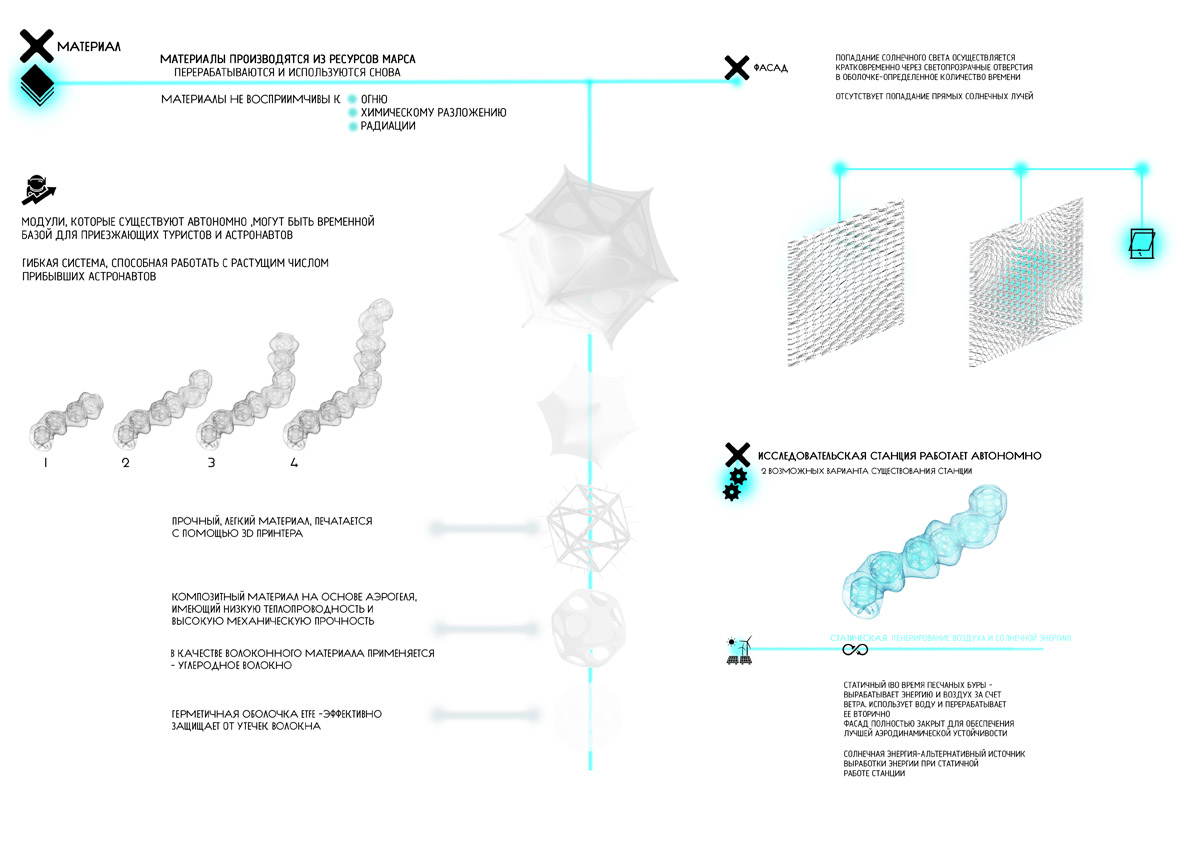
Materials are produced from the resources of Mars, recycled and used again. They are not susceptible to fire, chemical decomposition or radiation.
A strong, lightweight material is printed with a 3D printer. The composite material is based on aerogel, with low thermal conductivity and high mechanical strength. Carbon fiber is used as the fiber material, and a sealed ETFE shell protects effectively against fiber leaks.
While inner modules are produced by ETFE membrane, the surface of the structure are covered by Dyneema fiber (UHMWPE ballistic fabric). Consideration frequent sand abrasion will happen to the bottom. Thus, a ceramic such as boron carbide is the best choice for the bottom protection.
Facade
Sunlight enters briefly through light-transmitting openings in the shell for a set amount of time. Direct sunlight does not reach the interior.
Life support
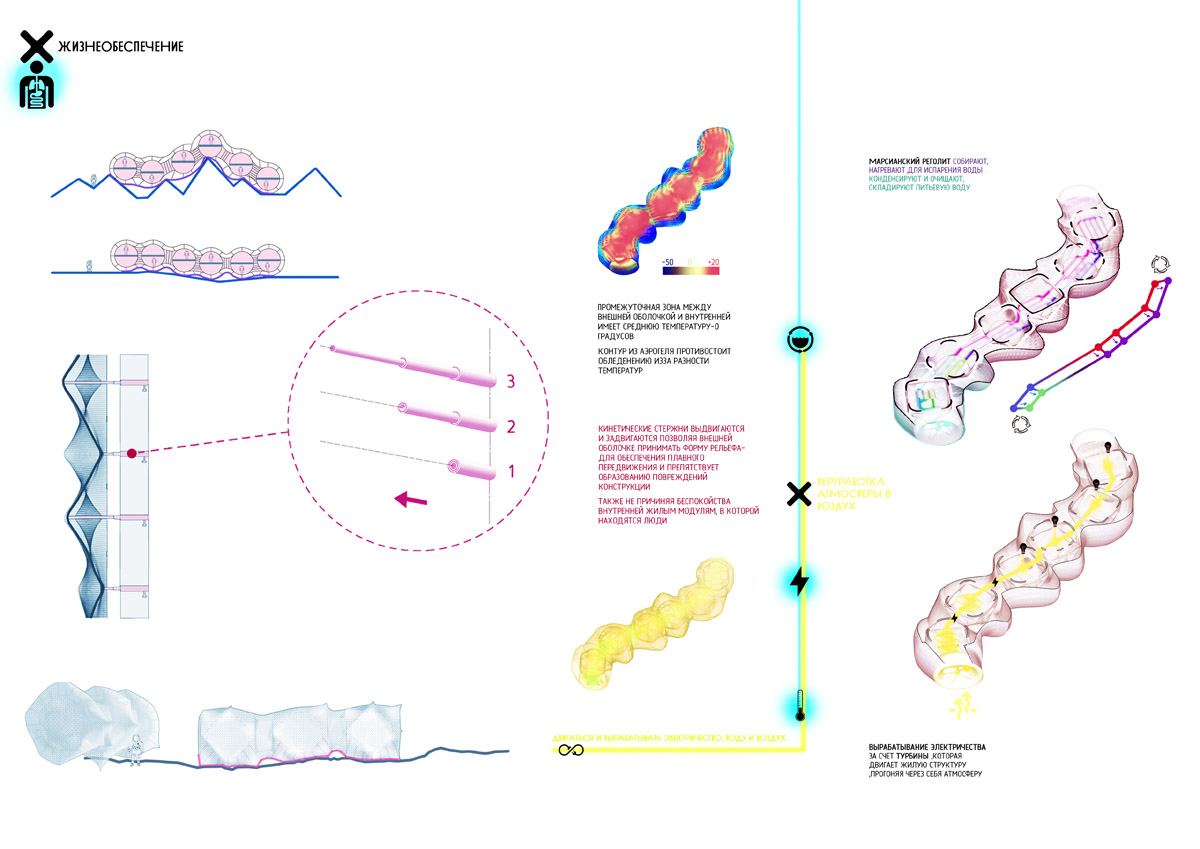
The intermediate zone between the outer and inner shell holds an average temperature of 0 degrees. An aerogel layer resists icing caused by the temperature difference.
The kinetic rods extend and retract so the outer shell can take the shape of the terrain, which keeps movement smooth and prevents damage to the structure, without disturbing the inner housing modules where people are.
Electricity is generated by wind turbine and is stored on board. Martian regolith is heated to evaporate, condensate, and purify water for drinking and water storage. Martian in situ resource utilization provides materials for technology fabrication and recycling.
Two ways to live
The research station works autonomously, and there are two possible modes.
Moving
The station travels, generating electricity, water and air as it goes.
Static
During sand storms the station stays put. It produces energy and air from the wind, uses water and recycles it. The facade closes completely for better aerodynamic stability. Solar energy is an alternative source of power while the station is static.
The full board
The complete competition board, with all systems together.