
Next generation racks
The payload rack is the unit that organizes every pressurized module ever flown. It was defined for the Shuttle era and no longer fits the vehicles, the stations or the crews it serves. This review looks at why the problem keeps coming back, and what a better rack would have to do.
The rack as it stands
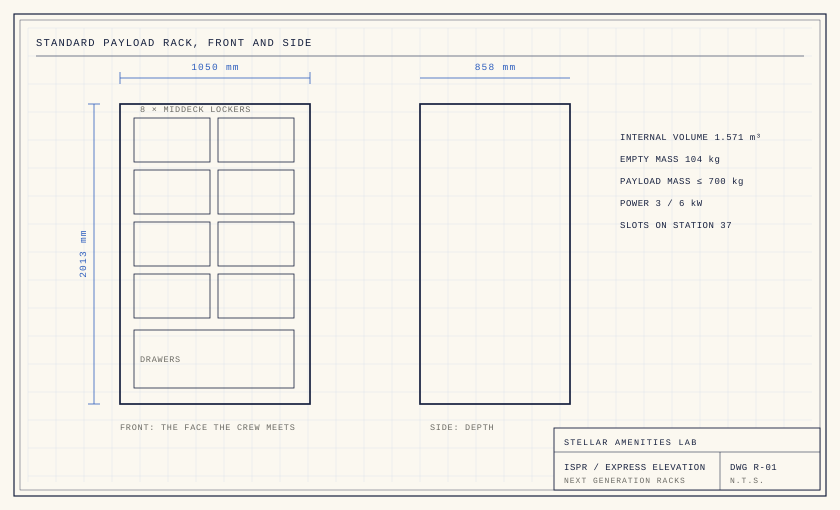
The International Standard Payload Rack is the common unit of every US, European and Japanese pressurized module. It is a frame roughly the size of a side-by-side refrigerator, with a standard set of power, data, thermal and vacuum interfaces, so a facility built for one module can fly in another.
The EXPRESS rack is the general-purpose version: a host that carries eight middeck lockers and two drawers, each with its own power, data and cooling allocation, so small experiments do not need a rack of their own.


What the standard got right
Interchangeability is the achievement. A payload integrated to the rack interface definition can be manifested into a different module, on a different partner’s segment, years later, and still plug in. Very little else in human spaceflight has that property.
The second achievement is subdivision. The locker and drawer sizes gave small teams a way into orbit without owning a facility, and set the de facto form factor for an entire generation of flight hardware.
Where it no longer fits
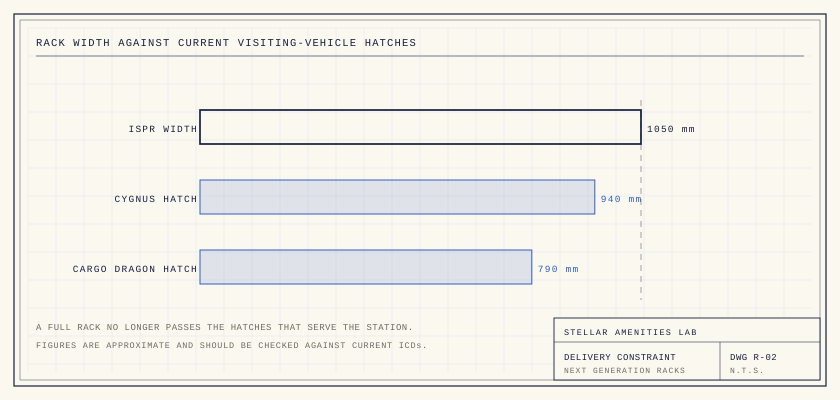
It cannot be delivered. A full rack is 41.3 inches wide. Cargo Dragon’s hatch is about 31 inches, and Cygnus about 37. Racks reached the station in the Shuttle’s logistics modules and in HTV; with both retired, the standard unit of outfitting no longer has a ride.
It was sized for payloads, not people. The rack face is the wall of the room. It is where a crew member braces, reads a label, finds a handhold and loses a bolt. None of that is in the interface definition, so it is solved separately, and differently, by every payload developer.
It became storage. Racks absorb the stowage a station accumulates. A unit designed for serviceable science hardware now frequently holds cargo bags, which blocks the interfaces behind them.
Maintenance is an afterthought. Connectors sit behind installed payloads. Work that should take minutes becomes a partial teardown, in a gloved, floating, one-handed posture.

Why it persists
The rack standard has been known to be a poor fit for years, and it has not moved. The reasons are institutional rather than technical.
Flight history beats new ideas. A rack interface with two decades of qualified payloads behind it is the safe choice on any single program. The cost of keeping it is paid later, and by someone else. This is the same heritage trap that keeps returning the toilet and the CO2 filters.
Changing it breaks the catalogue. The value of the standard is every payload already built to it. Any new unit has to carry that inventory forward or it strands the thing that made the standard worth having.
It has no owner. The rack sits between structures, life support, payload integration and crew interface. Each group touches it; none is funded to redesign it.
The failure is survivable. Nothing is lost when a rack is awkward. The cost comes out of crew time, maintenance hours and habitable volume, which are absorbed mission by mission rather than counted once.
A system for a better rack
Our proposal keeps what the standard got right, interchangeability and subdivision, and changes the unit so it survives the vehicles and stations now being built.
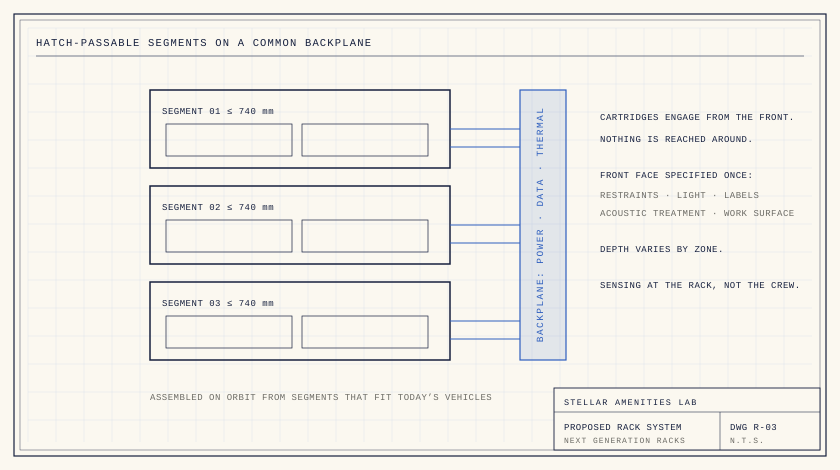
1. Hatch-passable modules. The rack stops being a single launched object and becomes a frame assembled on orbit from segments narrow enough to pass a 30-inch hatch. Interchangeability moves from the box to the backplane.
2. A real backplane. One structural, power, data and thermal spine at the back of the volume. Payloads become cartridges that engage it blind-mate from the front, so nothing has to be reached around.
3. The front face as a designed interface. Restraints, task lighting, labelling, acoustic treatment and a work surface specified once, at the rack level, instead of improvised payload by payload.
4. Variable depth. Not every function needs 859 mm. Shallow racks in habitation zones return volume to the crew; deep racks stay where the science is.
5. Stowage as a first-class rack type. If stations will store cargo in racks, one rack type should be designed for it, with its own access and inventory tracking, so science racks stop being closets.
6. Instrumented by default. Sound, light, temperature, airflow and use are recorded at the rack, which is where the crew actually meets the vehicle. That is the same intelligence layer we build elsewhere, placed in the furniture.
How we would prove it
The work is a physical mockup first: a full-height frame and two payload cartridges, swapped by a suited and unsuited subject against the clock. Then the same task in an analog habitat over several weeks, where stowage creep and maintenance access show themselves, and then parabolic flight for the handling that only microgravity reveals.
If you build stations, outfit modules or own a payload that has to survive the next decade of vehicles, we would like to compare notes.
Sources
- Columbus Payload Accommodation Handbook, ISPR configuration and power ratings
- EXPRESS Rack payload accommodations, locker and drawer interfaces
- Published ISPR dimensions, mass and station slot count
- Visiting vehicle hatch dimensions for Cargo Dragon and Cygnus
Figures are drawn from public documentation and should be checked against the current interface definition before use in a proposal.