
ExPod: next generation private crew quarters
Care in Space, presented
Slides from the Care in Space presentation of ExPod.
Overview
ExPod : the Experience Pod : is a next-generation living quarters that pairs multisensory immersion (visual, olfactory, auditory, tactile) with deep-pressure therapy to counter the behavioral-health stressors of long-duration missions. The need is documented: NASA tracks it as risk BMed-104, the risk of behavioral-health incidents tied to artificial habitable space on long missions. Long-duration crews lose the everyday sensory contact with Earth that keeps people grounded : open sky, the touch of another person, familiar smells : and no habitat module was designed to address it directly.
Design ExPod: a private module that lets an astronaut deliberately reconnect with Earth through sight, sound, touch, and scent, and prove it could be built from technology that already works on the ground.
We developed and pitched ExPod for the Care in Space Challenge : a competition, run with the Aurelia Institute and TRISH (the Translational Research Institute for Space Health), to advance crew behavioral health : and ran it as a systems-integration problem, assembling best-in-class terrestrial partners and qualifying each against spaceflight constraints : immersive projection with Barco and St&Antycip, full-body haptic feedback through CuteCircuit's HugShirt and SoundShirt, programmable scent, and five-sense interaction research with Robert LiKamWa's Meteor Studio at Arizona State University's Interplanetary Initiative. Our systems engineer led vendor coordination, CAD integration, NDAs, and a power-and-reliability assessment against ISS limits, including actuator lifetime and battery draw.
A validated concept and a working partner network for an immersive wellbeing pod, with the technical due diligence : power, durability, maintainability : completed against the realities of on-orbit operation. The concept was validated in review with NASA JSC's Chief Medical Officer. Specifics are held under NDA.
Our Care in Space Challenge presentation (starts at the ExPod segment).
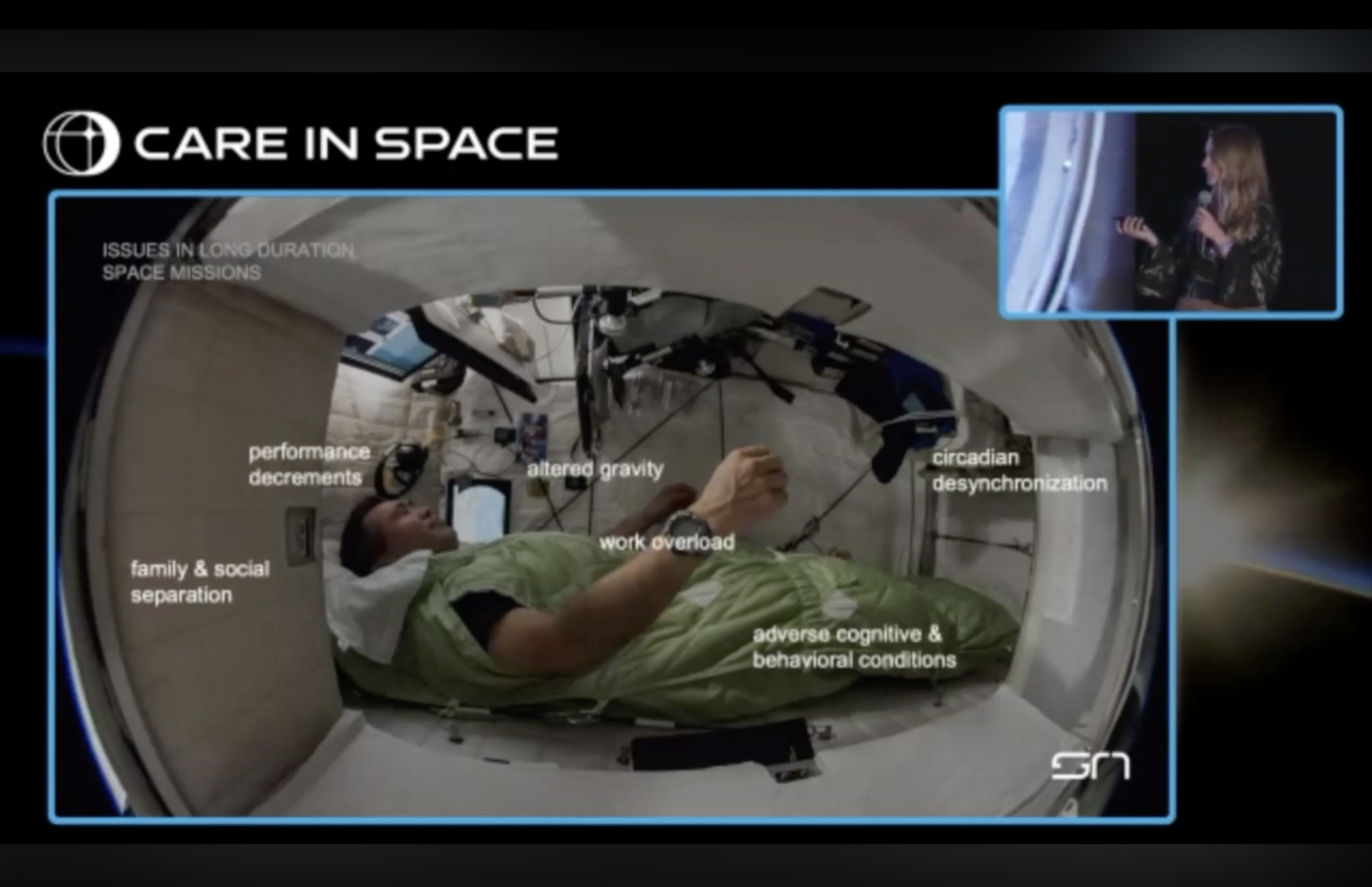
Issues in long duration missions
A crew member in a sleep station is exposed to all of these at once:
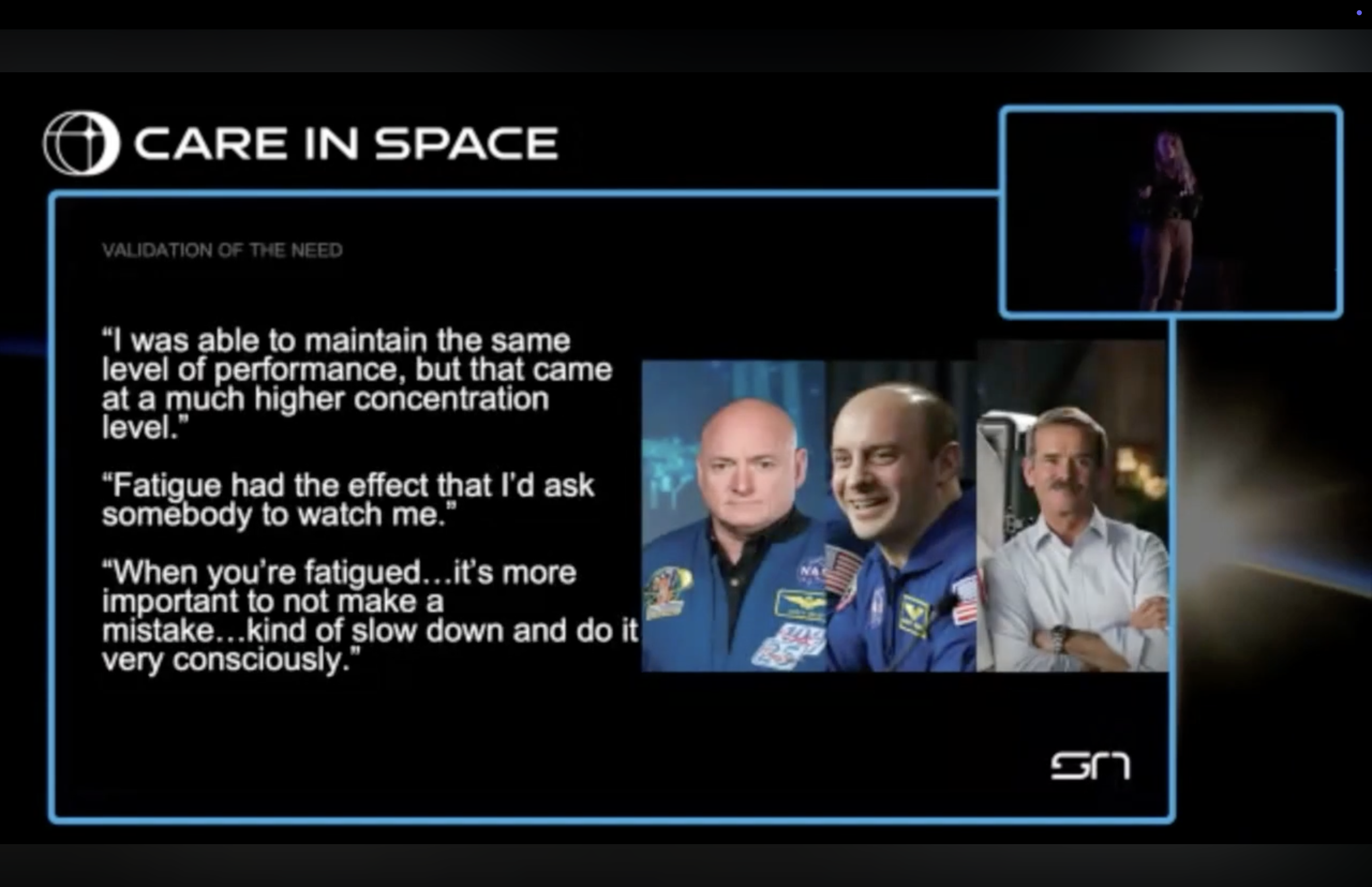
Validation of the need
Astronauts describe the cost of fatigue in their own words:
“I was able to maintain the same level of performance, but that came at a much higher concentration level.”
“Fatigue had the effect that I’d ask somebody to watch me.”
“When you’re fatigued… it’s more important to not make a mistake… kind of slow down and do it very consciously.”
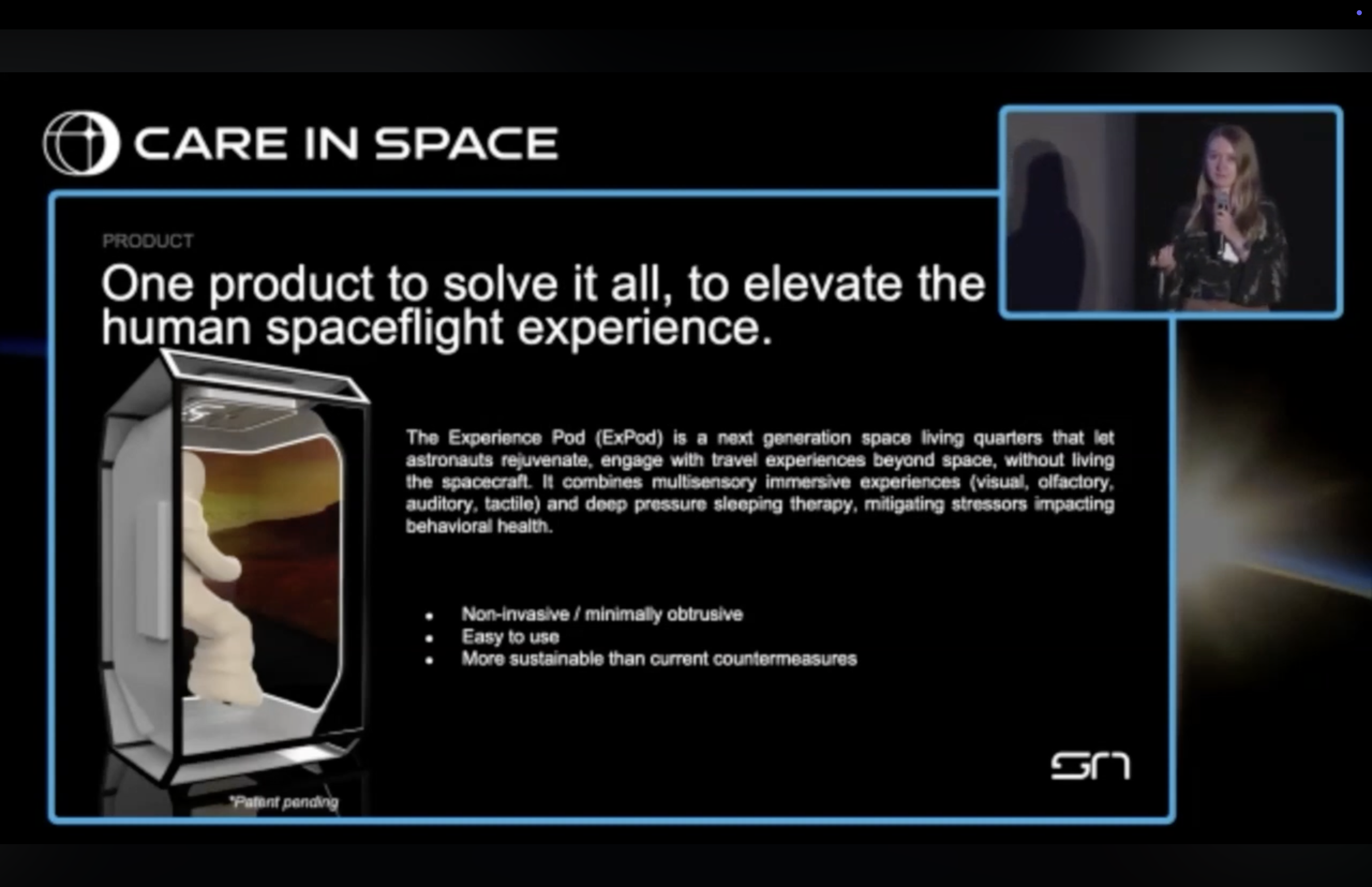
One product to solve it all
The Experience Pod (ExPod) is a next generation space living quarters that lets astronauts rejuvenate and engage with travel experiences beyond space, without leaving the spacecraft. It combines multisensory immersive experiences, visual, olfactory, auditory and tactile, with deep pressure sleeping therapy, mitigating stressors that affect behavioral health.
- Non-invasive and minimally obtrusive
- Easy to use
- More sustainable than current countermeasures
Patent pending.
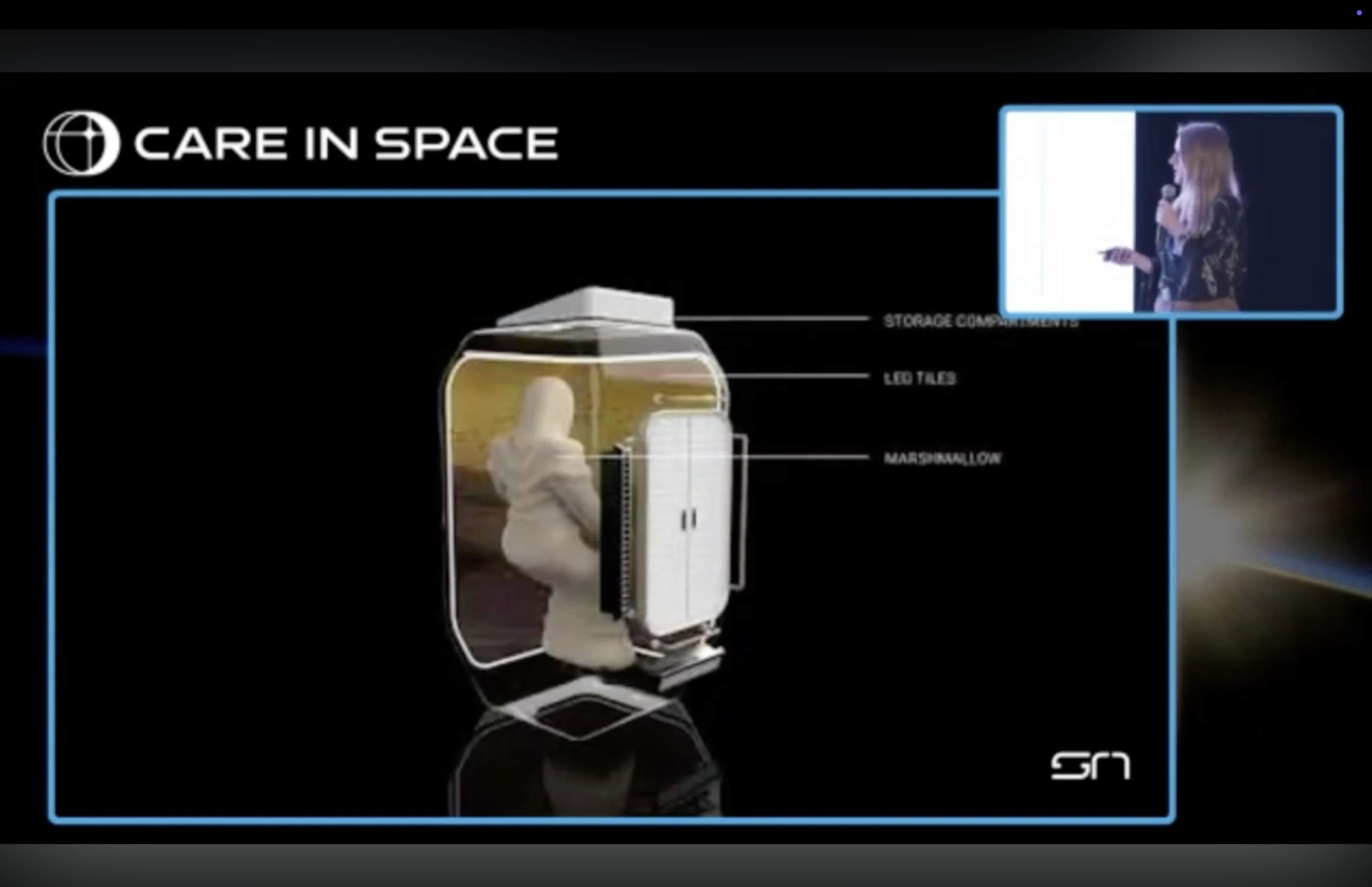
Inside the pod
LED tiles. The display surface itself, wrapping the occupant so a scene reads as an environment rather than a screen.
Marshmallow. The deep pressure element that holds and gently compresses the body during sleep.
Storage compartments. Stowage integrated into the shell, above the volume the occupant uses.
The partner stack
Projection. Barco and ST Engineering Antycip worked with us on the immersive display, sharing projector models and specifications so the unit could be integrated into the pod wall rather than mounted in the volume.
Haptics. CuteCircuit supplied the HugShirt and SoundShirt, their wearable haptic garments. ST Engineering Antycip introduced us to HaptX for force feedback, and to Motion Gestures, whose gesture interaction runs on standard cameras rather than dedicated sensors.
Five senses. Arizona State University’s Interplanetary Initiative introduced us to Robert LiKamWa of Meteor Studio, who works on engaging all five senses in an enclosed space so a crew member feels connected to Earth.
Three projection layouts
The immersive surface was studied as a CAVE: a volume whose faces are the display, rather than a screen a crew member looks at. We drew three versions, A, B and C, which vary in the amount of projection area, trading immersive capability against complexity, mass and cost. Each was drawn against the living quarter’s internal envelope with a figure for reference, and dimensioned surface by surface.
The constraint that shaped all three was viewing distance. The distance from the figure to the display is the maximum the envelope allows, which is short by the standards of any CAVE built on the ground, and it set the question we took to the display engineers: whether the experience still reads as immersive that close, whether the three versions differ in practice, and whether the image stays responsive to the limited movement a crew member can make.
Conventional CAVEs are rear-projected, which avoids shadows but needs a light path behind every face, often two meters or more. That footprint is plausible for a lunar base and impossible on a station. Direct-view LED tiles remove the light path entirely by emitting from the wall itself, at the cost of higher electrical power and heat to reject, and with the brightness and color to carry a daylight scene. The three versions were drawn around that technology.
Sound carried the same constraint in a different form. Display surfaces are not acoustically transparent, so the more faces that enclose a user, the more carefully the speakers have to be placed around them.
Qualifying it for a station
Every component had to answer the same questions before it could be considered for flight: what it draws, how long it lasts, and what happens when it breaks. A crew cannot send a garment back for repair.
CuteCircuit’s answers set the baseline. The vibration motors are encapsulated so the leads cannot detach, and the garment carries no internal wiring: a bespoke woven ribbon with conductive cores and strain relief at the interconnects. If one module fails, the others keep working. The system runs at 3.3 volts, and actuators can run continuously until the battery is empty.
We ran the same assessment across the stack: CAD integration, power draw against ISS limits, reliability, and the agreements needed to look at proprietary hardware. The result was a concept with a partner network behind it and the technical work already done.
What an astronaut told us
We sent the concept to Garrett Reisman, the former NASA astronaut, during the design phase. His note shaped the pod's interior:
“The ExPod is a cool idea and I like how it can be implemented on many different platforms (Orbital Reef, Starship, Axiom, etc.) My only suggestion for improvement would be to anchor at least the back of the upper torso to a hard flat surface so that when the MARShmello inflates it presses your back against that surface and gives the feeling of ‘lying down’. I think this would be preferable to being squeezed all-around while floating.”Dr. Garrett Reisman
The point was about where the pressure pushes from. Squeezing a floating body from every side is not the same sensation as lying down; a hard backing surface turns the inflation into weight.
The Care in Space Challenge
The Care in Space Challenge was run by Boryung, Axiom Space and Starburst Aerospace, at the intersection of commercial space and biomedical science. The prize was a $100,000 equity investment and a place in Starburst's thirteen-week accelerator.
ExPod was developed for the Care in Space Challenge, run by the Aurelia Institute with TRISH, the Translational Research Institute for Space Health, to advance crew behavioral health on long missions.
The challenge set the terms of the work. It asked for something that could plausibly fly, which is why the pod was assembled from technology already working on the ground and why each component was checked against ISS power, durability and maintenance limits before it entered the design.
Who built it
ExPod was developed through the 2022 summer program at Stellar Amenities, with Anastasia Prosina as creative director, Morgan Kainu managing, Brenda Williamson on operations and human factors, Kyle Meyers on human factors research, and Waheedah Akberzie and Adam Čtverák on systems engineering, integration and the concept of operations. Kriss Kennedy, James Ehrhart and Daniel Inocente reviewed the work as it developed.
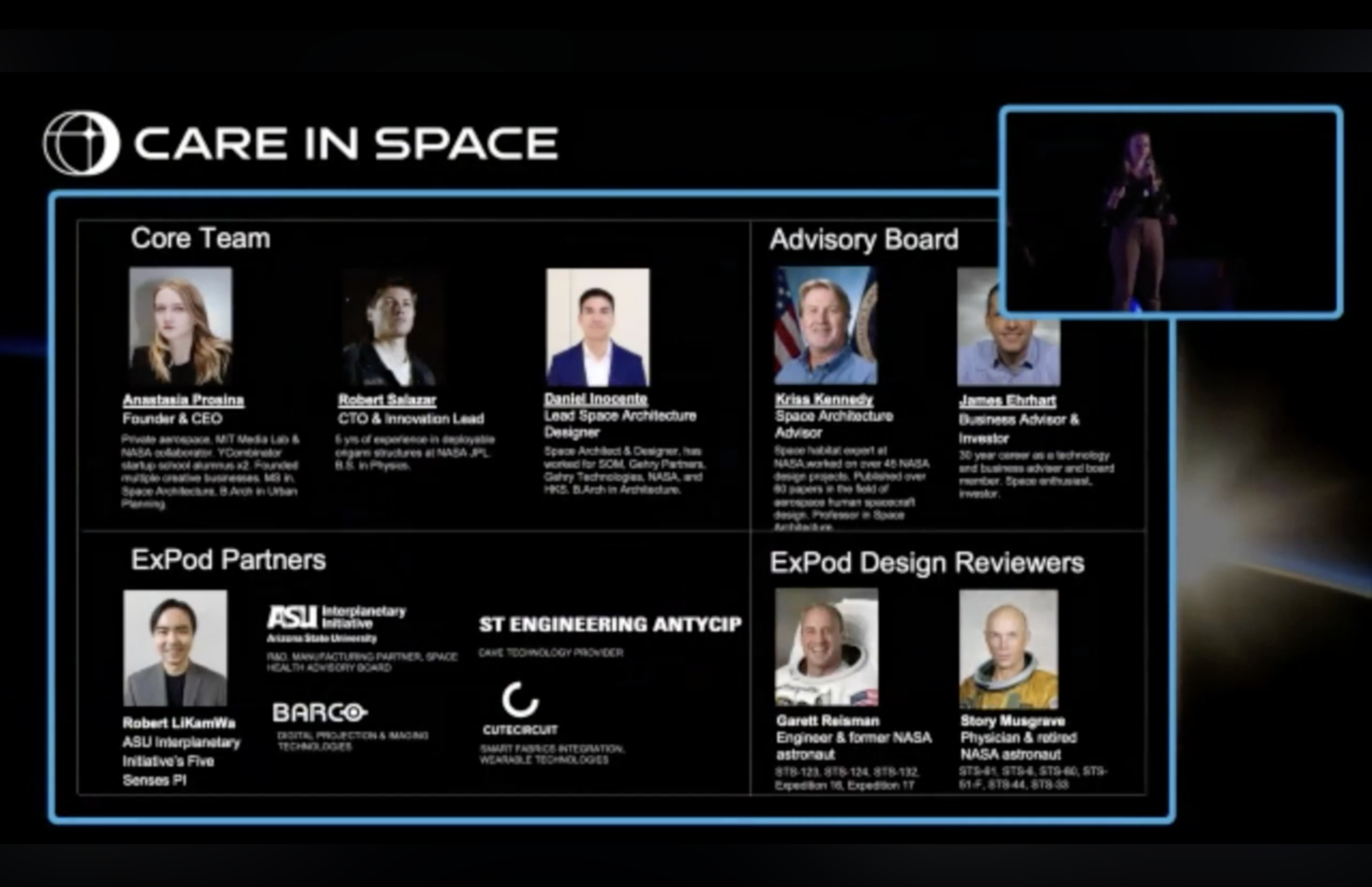
Core team. Anastasia Prosina, Founder and CEO; Robert Salazar, CTO and Innovation Lead, with experience in deployable origami structures at NASA JPL; Daniel Inocente, Lead Space Architecture Designer, previously at SOM, Gehry Partners, Gehry Technologies, NASA and HKS.
Advisory board. Kriss Kennedy, Space Architecture Advisor, a space habitat expert at NASA who worked on over 45 NASA design projects and published more than 80 papers in aerospace human spacecraft design; James Ehrhart, Business Advisor and Investor, with a 30 year career as a technology and business adviser and board member.
ExPod partners. Robert LiKamWa, principal investigator of ASU Interplanetary Initiative’s five senses work; ASU Interplanetary Initiative as R&D and manufacturing partner and space health advisory board; ST Engineering Antycip as CAVE technology provider; Barco for digital projection and imaging; CuteCircuit for smart fabrics and wearable technologies.
Design reviewers. Garrett Reisman, engineer and former NASA astronaut (STS-123, STS-124, STS-132, Expedition 16, Expedition 17); Story Musgrave, physician and retired NASA astronaut (STS-6, STS-33, STS-44, STS-61, STS-80).