
A greenhouse for the Martian surface
The brief
The 2019 BIG Idea Challenge asked teams to design a Mars greenhouse that complements the Mars Ice Home and helps support a crew of four on a 600-day surface mission. Entries had to work as architecture and as a life support system: food production, air revitalisation and water re-use, built from an inflatable structure and as much in-situ material as possible.
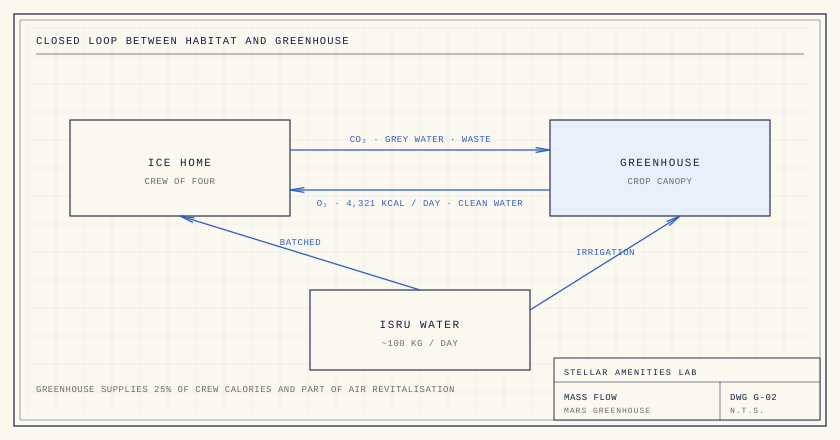
The constraints were hard. Landed mass under 18,000 kg, a packaged volume no larger than a 6.7 meter cylinder 9.3 meters high, a two-meter pressure door onto the habitat, and deployment by simple robotics before the crew arrives. Water comes from in-situ production at roughly a hundred kilograms a day, delivered to the greenhouse in batches.
What the crew needs
The greenhouse was required to supply a quarter of the crew’s diet. Calculated across crew of different sizes and sexes, with an extra 500 kcal for each of the two daily EVAs, the crew needs 17,286 kcal a day, so the greenhouse has to produce 4,321 of them.
Calories alone are not a diet. Protein has to hold at 12 to 15 per cent of total calories to offset muscle loss, carbohydrates around half, with simple sugars under ten per cent, and fats 30 to 35 per cent. That balance, not raw yield, drives which crops are worth their volume.
Choosing the crops
Space agriculture has sixty years of false starts to learn from. Early programs favoured algae: Chlorella is hardy, productive and easy to culture in reactors with the light source embedded in the vessel. But many algae carry too much protein and nucleic acid for a balanced diet, and too much indigestible cell wall.
The Soviet BIOS tests found something sharper. When the atmospheres of the algal and plant chambers were connected, wheat was stunted and sterile, potato and tomato stopped growing, cucumbers stopped flowering, and beet leaves reddened. The likely cause was an unidentified volatile produced by the algae. Coupling two living systems is not free.
Running the numbers on algae settled the question for us. Even with the most productive organism and the most generous assumptions about light and power, a greenhouse of this size cannot feed a crew of four on its own. It supplements a stowed diet; it does not replace one. The 25 per cent target in the brief is not a modest ambition, it is close to what the physics allows.
Later NASA crop lists targeted carbohydrate, protein and fat together, and converged on wheat, soybean, potato, rice, sweetpotato, lettuce and peanut. Potato in particular reached tuber yields near 19.7 kg fresh mass per square meter with a harvest index of 0.7 to 0.8, meaning comparatively little inedible waste, and a 1995 Shuttle experiment showed tubers form as well in space as on the ground.
Light and power
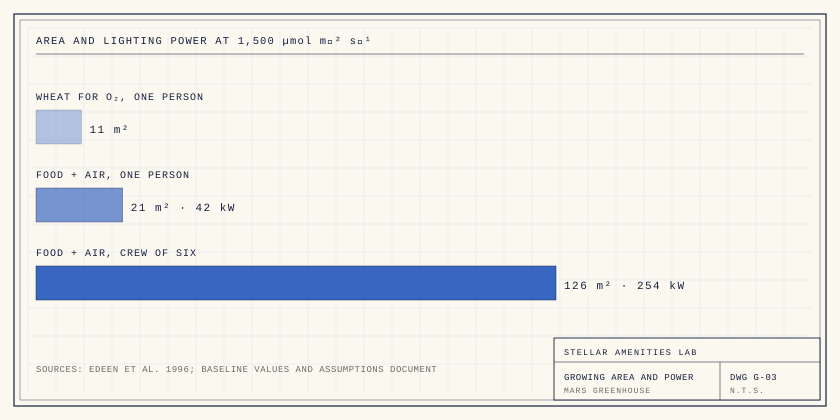
Light is the real cost of growing food off Earth. At Johnson Space Center, 11 square meters of wheat at high light intensity produced the oxygen for one person, and during a 91-day closed test that stand regenerated the air for one of four crew members while equipment handled the rest.
Scaled for food rather than air, the numbers climb. Around 21 square meters of growing area per person at 1,500 µmol m−2 s−1 implies roughly 42 kW per person, or 254 kW for a crew of six, using the lighting power figures in NASA’s Baseline Values and Assumptions Document. Converting sunlight to electricity and back into light is a losing trade on a planet that receives 43 per cent of Earth’s sunlight and is prone to dust storms.
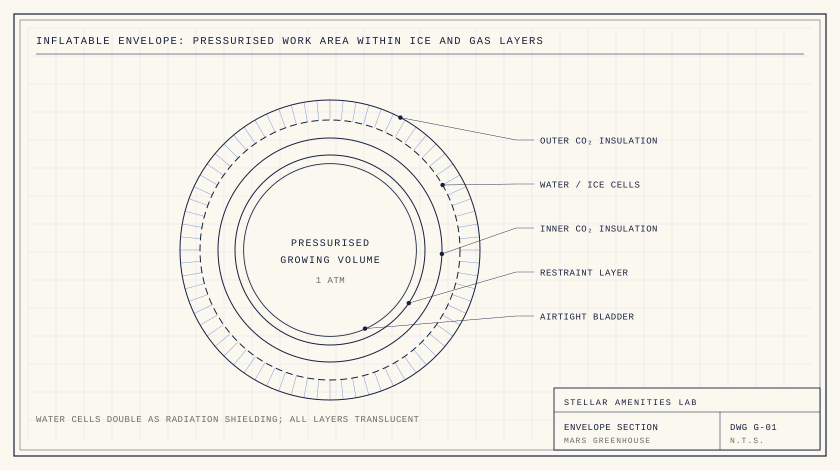
The design therefore treats daylight as the primary source, through the translucent layers of the Ice Home envelope, with insulation blankets that cover the structure at night against heat loss and fold back as reflectors by day to add light to the canopy.
A place, not a machine
Confinement and isolation grow heavier with mission length, and the need for volume and privacy grows with them. A greenhouse is the one part of a Mars outpost that is warm, green and alive, so the design treats it as somewhere the crew would choose to be: room for gardening and for leisure, and a processing area where plants are cut, sorted for eating and returned to the loop.
Team
Anastasia Prosina (University of Houston), Myroslava Hiser (Ohio State University), Robert Salazar (University of California, Santa Barbara) and Christopher Esquer-Rosas. Faculty advisor: Larry David Toups, Sasakawa International Center for Space Architecture, University of Houston.
Algae, and what it could build
The algae work that followed this project went further than food. Algae grow by absorbing carbon dioxide and producing starch, which can be processed into bioplastics or into a binding agent for regolith. Oxygen is a by-product. The water tanks they grow in double as radiation shielding, and they do not need fresh water.
That makes algae a candidate printer ink. A 3D-printed mixture of algae and regolith would avoid the intensive mining and sifting that a purely mined filler demands, because algae is a controlled biological medium cultivated in a laboratory rather than a site-specific material that has to be processed before use.
The same biomass is high in protein and has natural thermoplastic qualities, so the cellulose and sodium alginate it produces can be printed into biodegradable fabrics for clothing, bedding and furniture, and its oils can be processed into high-density biofuels. Algae is not a short-term solution, but over a long stay it is the one input that feeds, shields, clothes and builds.