
Space Hug: a deep pressure therapy suit for sleep in space
On Earth, gravity gives the body a constant, calming sense of being held. In microgravity that disappears, and with it a source of comfort that supports sleep and stress regulation.
Improving sleep in microgravity
Slides and flight footage from the Zero-G flight stories talk for the AIAA Space Architecture Technical Committee.
Why sleep
Without solving sleep, the commercial space station economy and the lunar habitation timeline are at risk. Studies show astronauts can lose up to 42% of their deep sleep in microgravity.
Deep pressure stimulation is well established on Earth for neurological regulation, yet there has been very little research on how pressure sensation changes in microgravity or how it could be used as a countermeasure. That is both a scientific gap and a commercial opportunity.
The goal
Build a wearable that restores gentle, adjustable deep pressure, the proprioceptive input behind weighted blankets and hug therapy, in an environment where weight no longer does the work.
Our approach
We developed Space Hug around a soft, even pressure system that functions without gravity, studying actuation, materials and comfort for extended wear, and drawing on wearable haptics and sleep-garment prototyping.
A follow-on study in 2024 asked how applied pressure behaves and is perceived once gravity is gone, connecting wearable design to measurable human response.
The flight
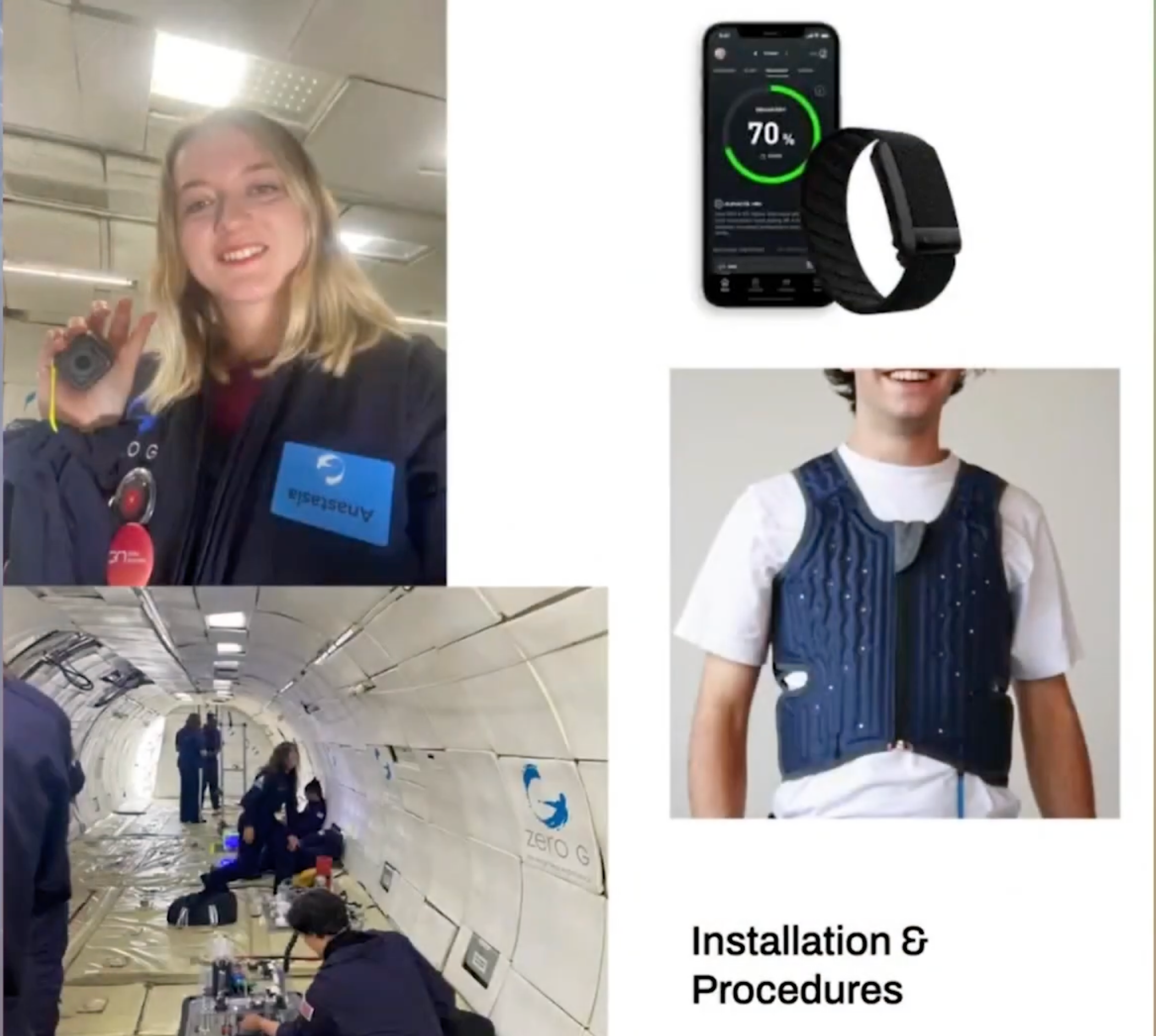
The research tests whether targeted pressure of 4 to 6 kPa can counteract sleep disruption in microgravity. Anastasia flew as both designer and test subject, representing the AIAA Space Architecture Technical Committee alongside Robert Howard, Ph.D., of NASA, to collect first-of-its-kind data on this approach.
Space Hug was developed with feedback and support from Sean Auffinger, Halle L., Smith Johnston (NASA JSC and Axiom Space), Cady Coleman, Ph.D., Sandra Haeuplik-Meusburger, Christina Ciardullo, AIA, and Ariel Ekblaw.
“Based on peer-reviewed studies and ongoing consultations with medical personnel at NASA’s Johnson Space Center, Anastasia’s research explores the potential for deep pressure therapy vests to manage stress in spacefarers.”Aurelia Institute, on the Horizon Zero Gravity flights
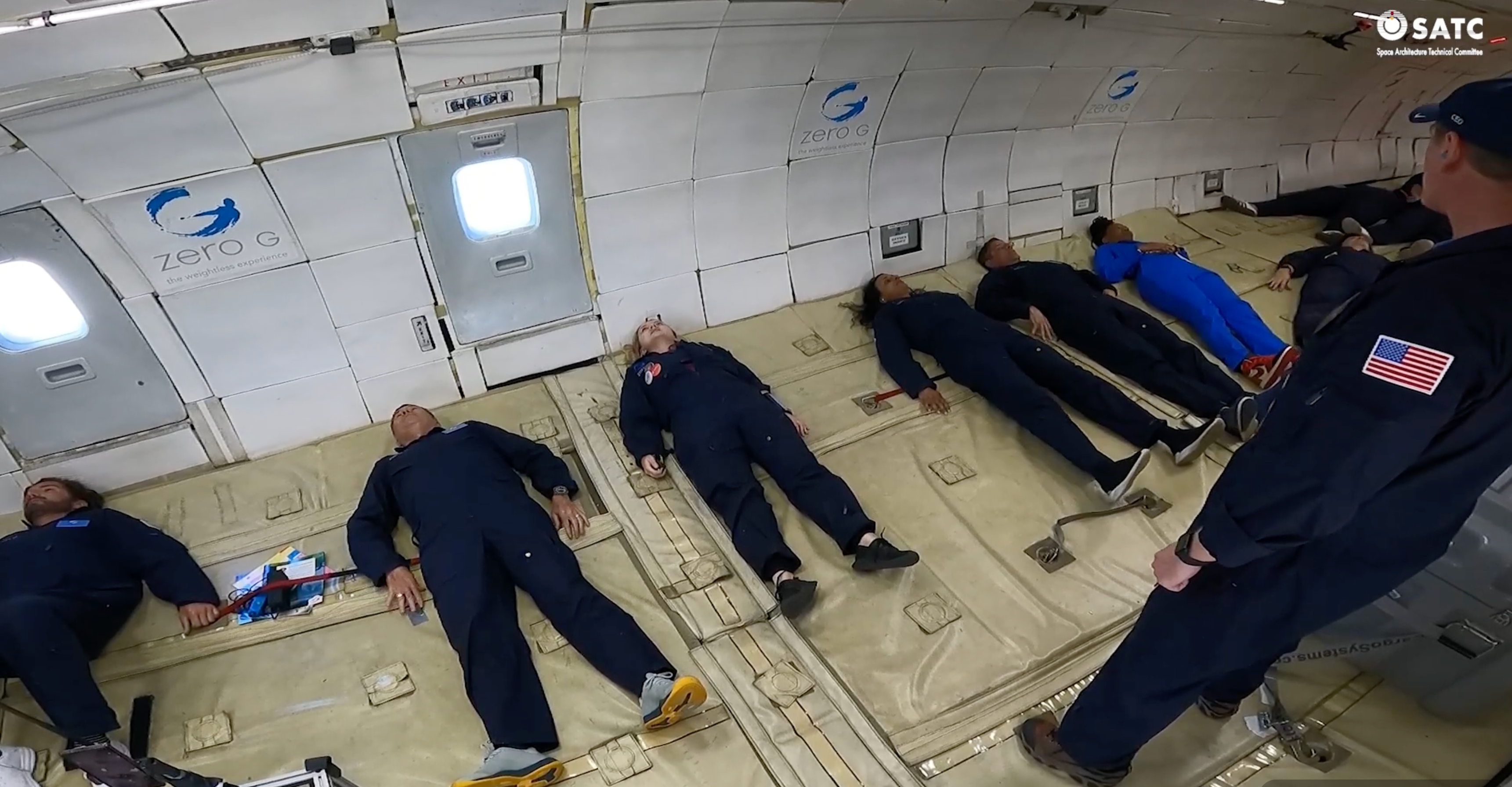
Space Hug flew on one of two back-to-back Aurelia Horizon zero gravity flights in May, which together carried 24 projects and 48 fliers. Astronauts often report the sensation of falling when trying to sleep and frequently need medication to fall asleep. The flight tested whether deep pressure can reduce that stress response, aboard G-Force One.
Outcomes
A working prototype and a research basis for deep-pressure countermeasures that support crew sleep and stress regulation on orbit.
Space Hug was tested in microgravity on an Aurelia Institute Horizon parabolic research flight. The pressure study produced evidence that now informs pressure-based wearables, replacing intuition with data.
The Horizon flight, flown with MIT, cycles through lunar and Martian gravity as well as weightlessness, so the suit was worn across all three. How the body carries its own weight changes in each one, and the pressure that reads as supportive in partial gravity is not the same as the pressure that reads as supportive in weightlessness.
The same flight produced a separate study of weight distribution and orientation in partial gravity. Read it here.
Presenting it to Axiom
We presented the work to Axiom Space and discussed it with their team, and in August 2024 Stellar Amenities followed those conversations with a letter of intent, stating our ongoing interest in acting as a supplier for Axiom’s commercial space station accommodations, with a product that uses otherwise passive time to the benefit of astronaut health.
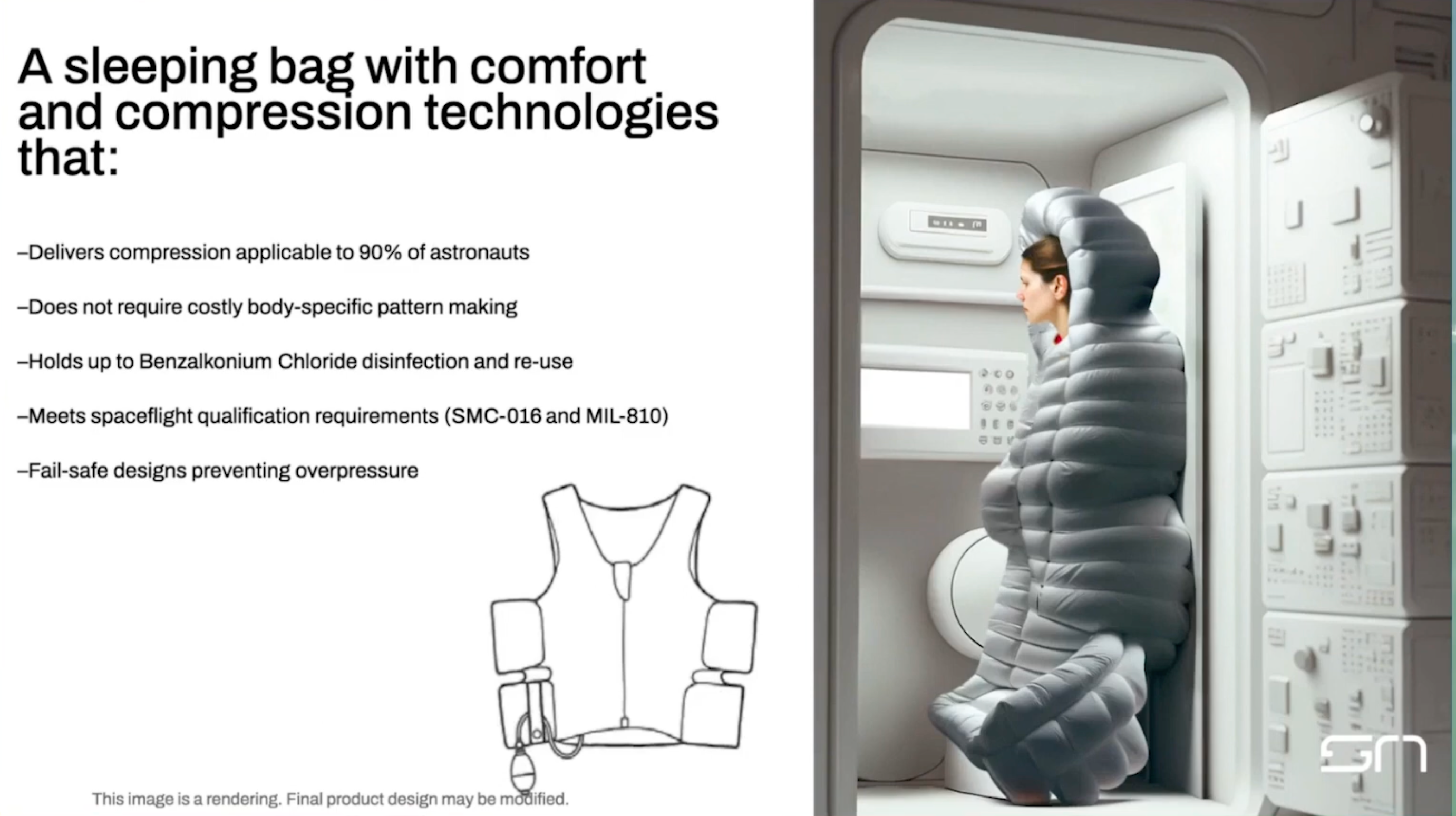
The letter described a comfort and compression garment that mimics the sensation of blankets in gravity and applies compression to manage the uncomfortable symptoms of microgravity fluid shifts: a low-profile, system-independent sleep garment that offers more than a standard sleeping bag while keeping a non-invasive interface with the station.
It also set out the platform behind it, for longer missions: customisable and trackable compression controls to increase comfort and vascularisation, ventilation to reduce CO2-borne headaches, radiation protection layers, and far infrared light to help reduce the risk of ischemia. The concept was offered as something that could be developed incrementally, aligned to Axiom’s forecast needs and mission durations, with meetings invited with their crew accommodations and medical teams to shape it around what they needed.
Engineering the soft goods
Halle Lowe, working as mechanical engineering consultant for Stellar Amenities, set out what a first prototype had to prove before it could be taken seriously as flight hardware. Seven criteria defined success:
The development path ran from design criteria and preliminary design review, through early prototyping to find failures in comfort and construction as soon as possible, to a feasibility pass that grouped the remaining risks by whether they would close for the prototype, for flight, or not at all.
The build followed the same discipline. A prototype can be made from non-flight materials, but as much of it as possible has to be manufactured the way a flight part would be, and every substitution has to be justified against form and function. Every issue found during and after the build, however small, was recorded in the style of an anomaly report: what the condition is, what it should be, and photographs before, during and after the fix.
Watch the flight
Footage from the parabolic flight, showing the garment in use across the weightless portions of the parabolas.
▶ Watch the flight on YouTubeAn inflatable sleeping device for Axiom
The same line of work, applied to a bed rather than a garment: a deployable sleeping device for the Axiom space station that holds a body still, wraps it gently and keeps the air around the face clear.
Axiom: the problem
A factor that greatly affects the health of astronauts who inhabit any space station is the quality of sleep. Through the years of the space missions, the sleep of astronauts has been monitored, reporting sleep deficits, in particular of the REM phase, due to various factors.
The adaptation of astronauts to weightlessness in particular affects the quality of their sleep, together with the alternation of sunrises and sunsets that occur with high frequency in orbit, shifting the regular circadian rhythm.
With a view to future exploration and space tourism, it is therefore essential to plan sleep areas that promote the wellbeing of their users and occupy acceptable volumes, considering that every cubic millimetre in space is precious.
Axiom: requirements
- 01The device must ensure rest and comfort for the user.
- 02Given the absence of gravity, the device can be positioned vertically.
- 03The device must contain the astronaut as much as possible, so that they do not float during sleep and hit other surfaces.
- 04The device must occupy the least possible volume: an inflatable or deployable solution is recommended.
- 05The device must ensure correct recirculation of air around the user’s mouth. During sleep it is common for carbon dioxide produced by breathing to accumulate, which must be cleared through good ventilation, so the areas near the mouth must remain free.
- 06The device must comfortably embrace the user: research has shown that in space there is no longer the sensation one feels on Earth of being gently wrapped in our bed.
- 07The device must have a design in line with the design of the space station, being made for paying users who will expect a highly functional and pleasantly aesthetic instrument.
Axiom: the inflatable device
The solution is an inflatable device made up of different sectors. The mattress material is breathable and light, and allows the mattress to remain inflated without air leaks while staying comfortable against the skin.
The mattress has lateral containment walls that enclose the user inside and act as a hook for the upper cover, which is also inflatable. The upper cover is made up of inflatable cylindrical sectors, covered in a comfortable material such as suede, which swell slightly to compress the upper part of the user’s body.
The inflation pressure must be such that the sectors inflate differently according to the area they cover, wrapping the person lying down without exerting pressure. A similar inflation system is used in hospital mattresses to avoid the formation of sores in patients who have to stay in bed for long periods.
The inflation system must be positioned far from the mattress, so that the noise of the compressor does not disturb the person during sleep, which means an adequate system of pipes and connections has to be worked out.