Gravity shapes taste
Does gravity change what we find beautiful? A study by the psychologists Maria Gallagher and Elisa Raffaella Ferrè is the first to test the question directly.1 The psychology of aesthetics has a long tradition of studying how simple features, such as lines, forms, colours and shapes, shape preference, and recent work has asked whether people prefer symmetry and particular orientations in artwork. Artists have long treated the vertical as meaningful. Until this study, no one had linked the body’s gravitational signals to a preference for verticality.1
The question
On Earth the vertical is defined by gravity, and the brain finds it by combining signals from the inner ear with vision, touch and the sense of the body’s position. Gallagher and Ferrè asked two things: whether people have an aesthetic preference for simple vertical lines, and whether that preference depends on the current position of the body relative to gravity.1
Four experiments
What they found
When participants were upright and aligned with gravity, a clear preference for vertical lines emerged. When the head and body were tilted to the left or right, the preference diminished. In the control experiment, no preference for horizontal lines appeared, even when participants were tilted by 90 degrees.1
The authors also noticed a pattern among the tilted lines. Lines close to vertical, but not quite, were liked least. They suggest a kind of lateral inhibition, in which near-vertical lines are disliked in favour of truly vertical ones, while cautioning that these differences were not statistically significant.1
Ruling out the easy explanations
The lines were identical in every posture, so the result cannot come from the image alone. Symmetry and the position of the lines on the retina were held constant across conditions.1
Familiarity was the next candidate. People tend to prefer what they see often, and vertical lines are more common in natural scenes than oblique ones. Mondrian paintings, built from horizontal and vertical lines, are preferred over the same paintings rotated so their lines become oblique.2 Fluency was another: people perceive horizontal and vertical contours more accurately than diagonal ones, a finding known as the oblique effect.2 Both accounts predict a preference for vertical lines whatever the viewer’s posture. In the study, the preference appeared only when participants were upright, so neither familiarity nor ease of processing is enough to explain it.1
Gravity, posture and meaning
Gallagher and Ferrè connect the result to embodied cognition, the idea that abstract concepts are tied to physical sensation. People sitting upright report more pride than people who are slumped, and recall more positive memories when they perceive themselves moving upward. In art, verticality has been used to express power, status, morality and grandeur, and associations between up and good, and down and bad, are common. An upright body may lend its sense of rightness to the vertical lines it sees.1
Our judgments of attractiveness may owe more to multisensory gravitational perception than has previously been thought.Gallagher and Ferrè1
Their conclusion is that the low-level features of an image have to be integrated with the position of the person looking at it, and that gravity modulates aesthetic preference through live signals from the vestibular system.1 If taste depends on posture relative to gravity, preferences in a weightless cabin, or in a lunar habitat at one sixth of Earth’s gravity, may differ from the ones designers bring from Earth. The rest of this essay follows that question into the body, into flight, and into the design of places where people will live.
How the body finds up
On Earth, gravity is always present, and the body uses it constantly to keep balance, move and read its surroundings. The inner ear does much of this work. Three semicircular canals detect rotation of the head, and the otolith organs detect linear acceleration and gravity. In the otoliths, tiny crystals rest on thousands of hair cells. When the head tilts, the crystals shift and bend the hair cells, which tell the brain where the head is relative to gravity.
The brain combines these signals with vision, touch, the sense of where the limbs are, and a strong prior assumption that the body is upright. Researchers have argued about the balance since the 1930s. Some held that the vertical is mainly a visual judgment; James Gibson argued that posture and gravity acting on the body matter as much.3 Later studies support the view that several senses contribute, and that the brain relies on whichever cues are most reliable at the moment.4
The prior shows up in a well-known bias. When people tilt their head and body far to one side, beyond about 60 degrees, a line they set to look vertical is rotated toward their own tilt. This is the Aubert effect, first described by Hermann Aubert in 1861.5 People with reduced somatosensory perception, the sense of the skin, muscles and joints, are largely immune to it.6
Clinical cases show how much the vertical depends on the inner ear. Patients with disorders of the peripheral vestibular system, or with lesions affecting the vestibular nuclei, make biased judgments of the vertical. Artificially stimulating the vestibular organs has the same effect: during galvanic vestibular stimulation, a small current applied behind the ears, people’s settings of the vertical shift toward one side.
Even healthy, upright people are slightly off. Asked to align a tilted line with the true vertical, they typically miss by around two degrees. Imaging studies show that vestibular signals reach many areas of the cerebral cortex, and recent work suggests that gravitational input from the otoliths also influences cognitive tasks, not only balance.
Testing it in flight
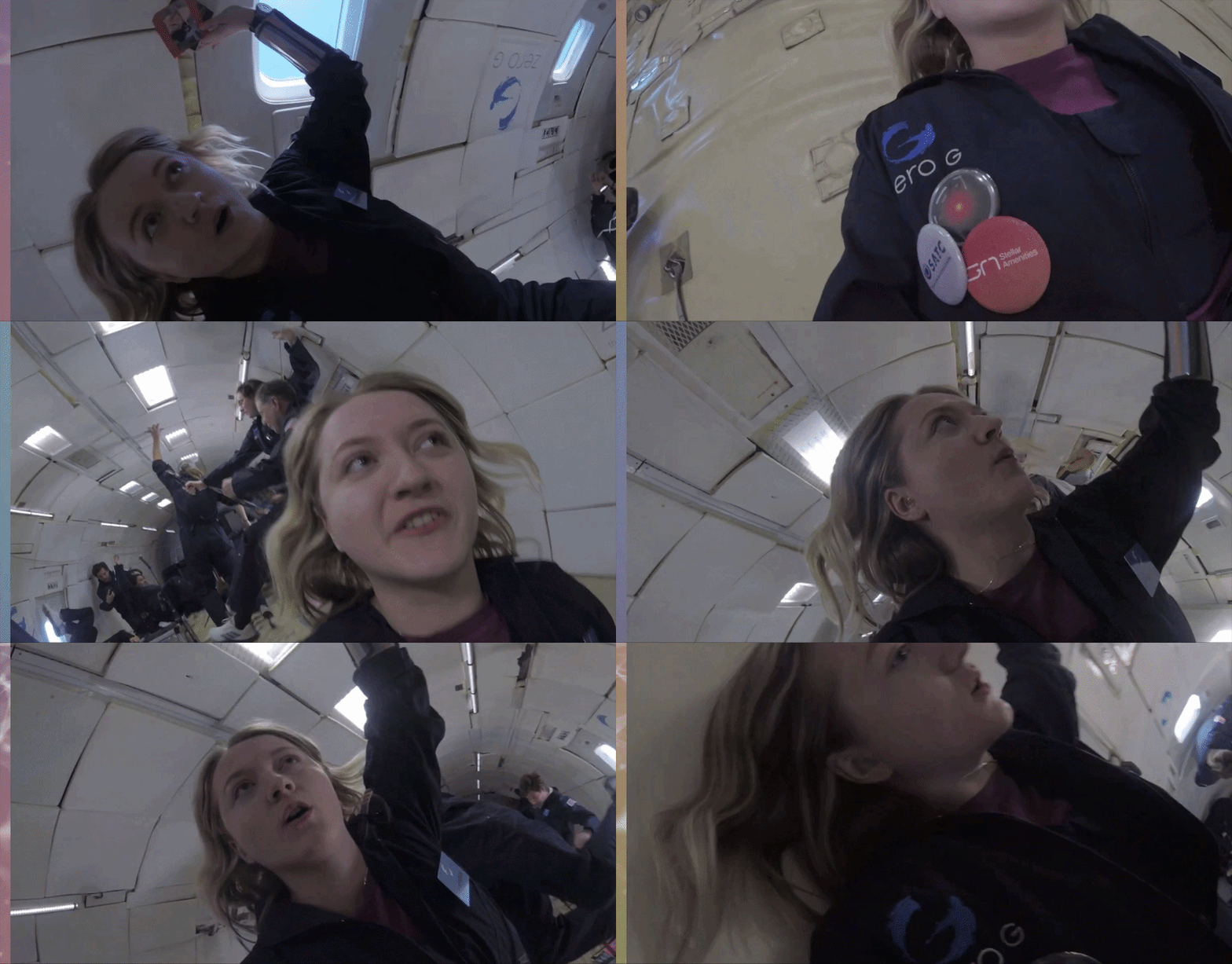
In May 2024 I flew on one of two back-to-back Aurelia Institute Horizon zero gravity flights, flown with MIT aboard G-Force One. The two flights carried 24 projects and 48 fliers. I flew as a test subject, representing the AIAA Space Architecture Technical Committee alongside Robert Howard of NASA.7
The aircraft flew a series of parabolas that cycled through lunar gravity, Martian gravity and weightlessness. In the weightless parabolas the cabin still had a floor, a ceiling and walls, but none of them was down. Fliers lay, floated and turned in every orientation, and up became wherever your head pointed. The same flight produced the Lab’s separate study of how the body carries its weight and finds down in partial gravity.
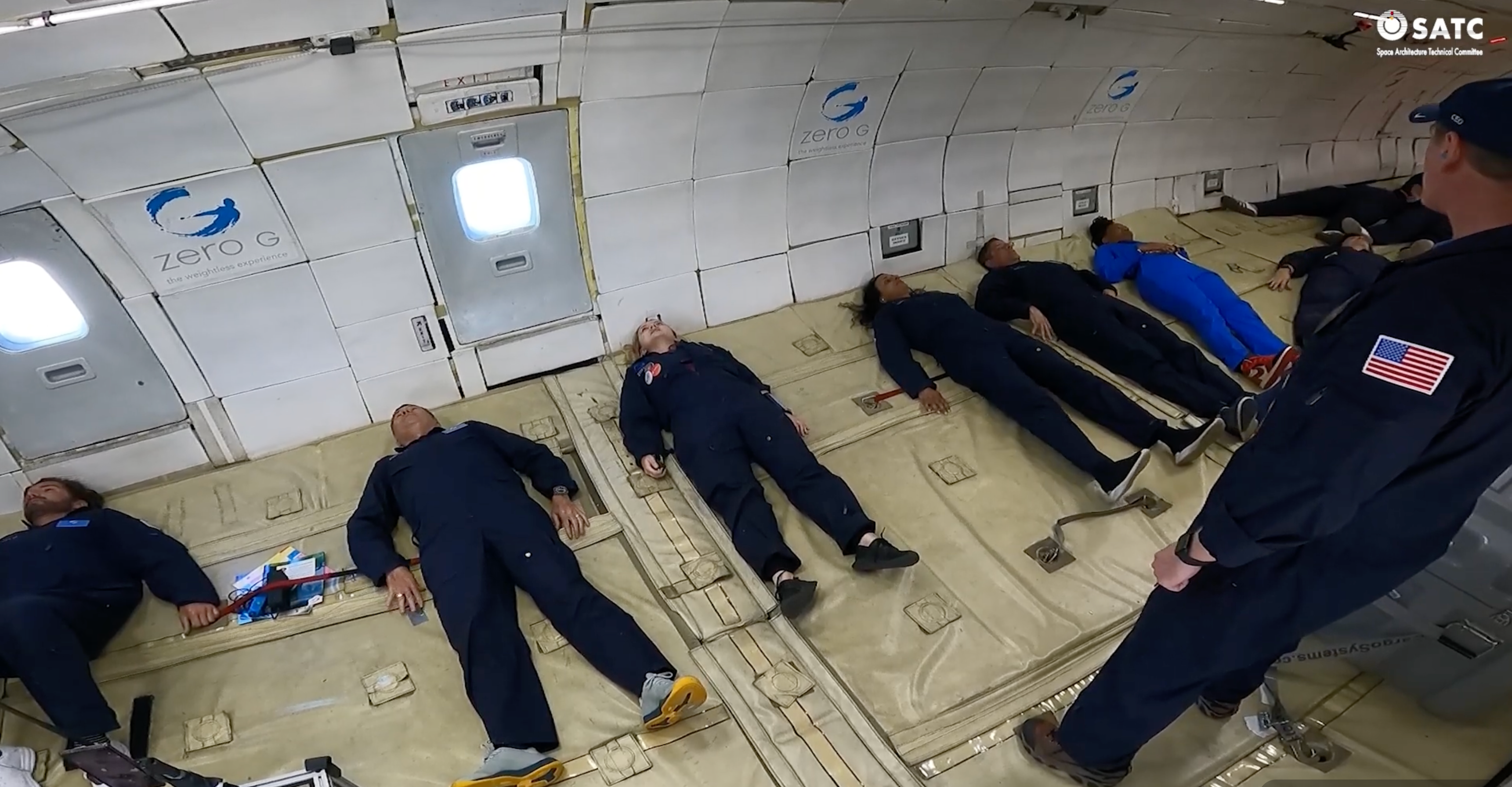
Astronauts describe the same thing. Without gravity there is no vertical, and the signals the brain normally uses to find it stop agreeing with each other. That mismatch is one cause of space adaptation syndrome, the disorientation and nausea many crew members feel in their first days in orbit.8 The advice astronauts give is to let the visual system decide that up is where your head is and down is where your feet are.
Designing for a body without a vertical
Spacecraft interiors are already shaped by this problem. Without a floor that gravity defines, crews rely on visual conventions: a consistent ceiling and floor within each module, lighting placed overhead, labels that all read the same way. When two modules meet at an angle, crew members moving between them have to reset their sense of up, and many describe the moment as disorienting.
The Lab’s partial gravity study on the Horizon flight looked at the same question from the other side: what tells a person which way is down when gravity is weak, and how strong a visual reference needs to be. Horizontal floor lines turned out to be a useful cue for both down and heading.
If preference for vertical lines depends on being upright, then interior design for space cannot rely only on what looks right on Earth. A layout that feels calm and ordered to a designer standing at a desk may feel arbitrary to a crew member floating at an angle to it. Comfort, wayfinding and even taste become variables to test in flight, not assumptions carried up from the ground.
A body that grew up lying down
While at Evermay as Fall 2026 Future Fellows, Viktoria Modesta, the bionic artist, and I compared our experiences of weightlessness and read the study together.9 Viktoria flew as one of the twelve disabled ambassadors on AstroAccess Flight 1 in October 2021,10 and she also flew on the Aurelia Institute Horizon flights. Stellar Amenities worked on that flight too, designing tactile textiles and handles so that blind and low vision ambassadors could find their way by touch in any orientation.
Viktoria spent much of her first ten years lying down. The phrase that stopped her was the prior about the normal upright stance of the body. If the brain builds its internal model of the vertical partly from years of standing, she asked, what model forms in a body that spent those years horizontal?
If most of us built our sense of up while standing, that model may work against us in space, where standing has no meaning. Someone whose senses developed in a different posture, or who lives with a body that does not move the way most bodies do, may adapt to weightlessness differently, possibly better.
That is the premise of AstroAccess, which flies disabled scientists, veterans, students, athletes and artists on parabolic flights. People whose bodies have already adapted to unusual conditions on Earth carry information about adaptation that a cohort of upright, able-bodied test subjects cannot provide. I spoke about this work, and the tactile navigation we designed for AstroAccess, at the European Space Agency’s webinar on Accessibility in Human Spaceflight.
Viktoria’s questions point to a gap in how crews are selected and studied. Most of what we know about adaptation to spaceflight comes from a narrow group of people: trained, upright, able-bodied and mostly similar in how their senses developed. If the brain’s model of the vertical is built partly from a lifetime of posture, then people with different postural histories are not edge cases. They are the population that could tell us which parts of adaptation are fixed and which are learned.
What comes next
The Lab plans to measure how people with different postural histories judge the vertical before, during and after parabolic flights, and to add those measurements to its record of how the body changes in space.
Sources
- Maria Gallagher and Elisa Raffaella Ferrè, “The aesthetics of verticality: a gravitational contribution to aesthetic preference,” Quarterly Journal of Experimental Psychology.
- Stuart Appelle, “Perception and discrimination as a function of stimulus orientation: the oblique effect,” Psychological Bulletin 78 (1972); Richard Latto, Douglas Brain and Brian Kelly, “An oblique effect in aesthetics: homage to Mondrian,” Perception 29 (2000).
- James J. Gibson and O. H. Mowrer, “Determinants of the perceived vertical and horizontal,” Psychological Review 45 (1938).
- James R. Lackner and Paul DiZio, “Vestibular, proprioceptive, and haptic contributions to spatial orientation,” Annual Review of Psychology 56 (2005).
- H. Aubert, 1861. The tilt of the perceived vertical toward a strongly tilted body is now called the Aubert effect.
- Horst Mittelstaedt, “A new solution to the problem of the subjective vertical,” Naturwissenschaften 70 (1983).
- Aurelia Institute Horizon zero gravity flights, May 2024: two back-to-back flights, 24 projects and 48 fliers aboard G-Force One. See Space Hug.
- Charles M. Oman, “Spatial orientation and navigation in microgravity,” in Spatial Processing in Navigation, Imagery and Perception, Springer, 2007.
- Evermay Future Fellows, Fall 2026 cohort, from August 21, 2026. Evermay was founded by Dr. Sachiko Kuno and Kate Goodall. evermay.org
- Mission: AstroAccess, Zero-G Flight 1, October 2021, with 12 disabled ambassadors. See AstroAccess.