
Desert Snowflake: A Self-Erecting Martian Dome
A deployable geodesic dome for Mars, and winner of the People’s Choice Award at Eleven Magazine’s Marstopia competition.
The competition
Desert Snowflake was our entry to Marstopia, Eleven’s ninth international competition and the sequel to Moontopia. The brief asked a single question: what does Martian vernacular architecture and design look like?
Out of hundreds of entries worldwide, Desert Snowflake won the People’s Choice award.
What it is
Desert Snowflake is a self-erecting, ultralight, deployable geodesic dome. It takes Buckminster Fuller’s ideas into a new century and works like architectural origami: it packs flat for transport and opens on site.
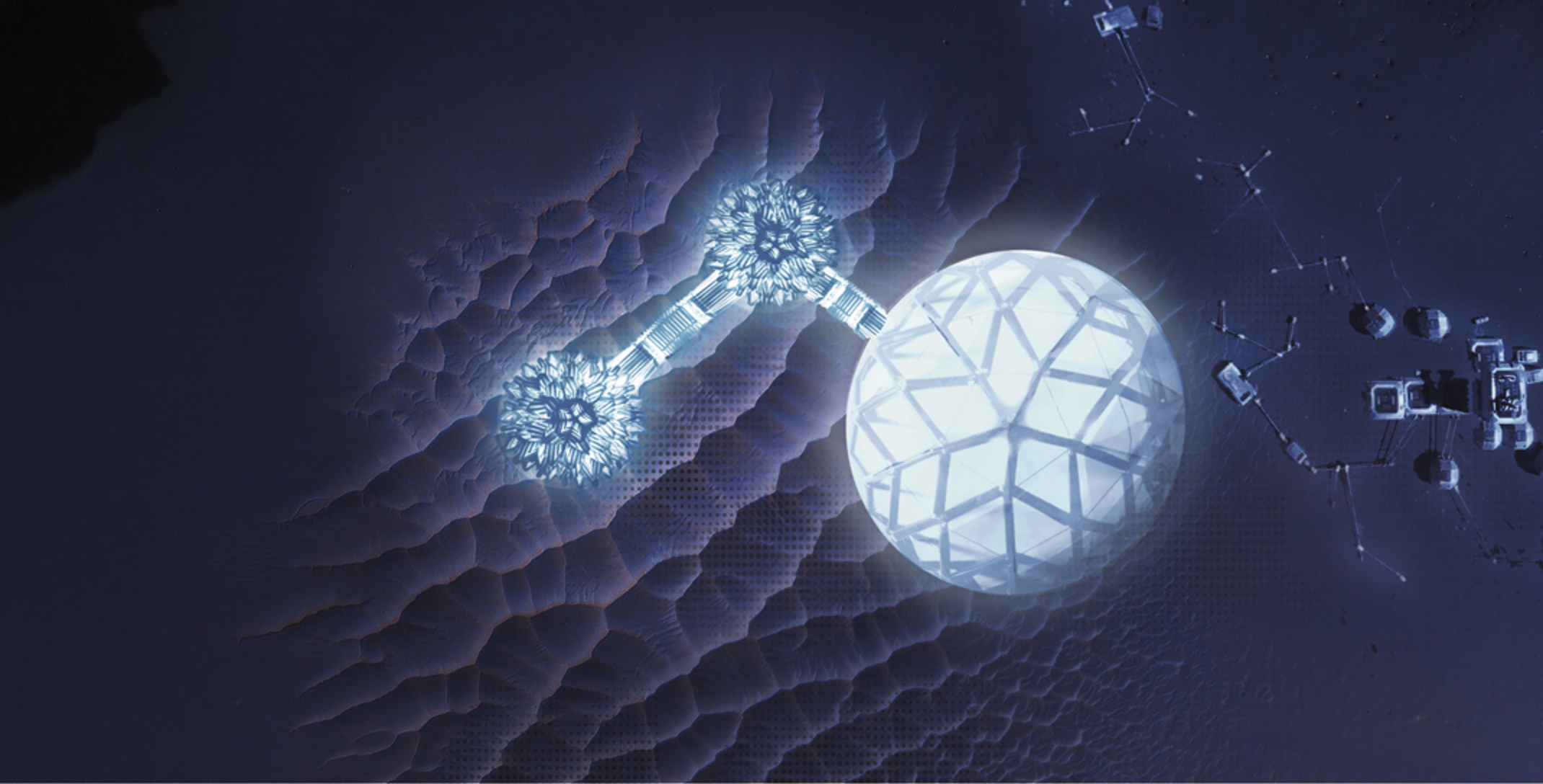
The spore-like structure is designed for adaptability and modularity, so a Martian colony can keep growing over time by adding new domes as it needs them.
Why it matters
Every kilogram sent to Mars is expensive, and every hour of crew time spent on construction is time taken from everything else. Structures that are light, pack small and erect themselves address both problems at once.
The project showcases the flexible, lightweight and robust construction systems that off-world settlement will depend on. The same thinking runs through much of Stellar Amenities’ later work.
Environment
The habitat would land inside a crater 900 m in diameter in the Deuteronilus Mensae region on Mars, where the geomorphology indicates large volumes of water ice in the regolith for many hundreds of kilometers abroad. The habitat would auto-erect on the dune field at the bottom of the crater.
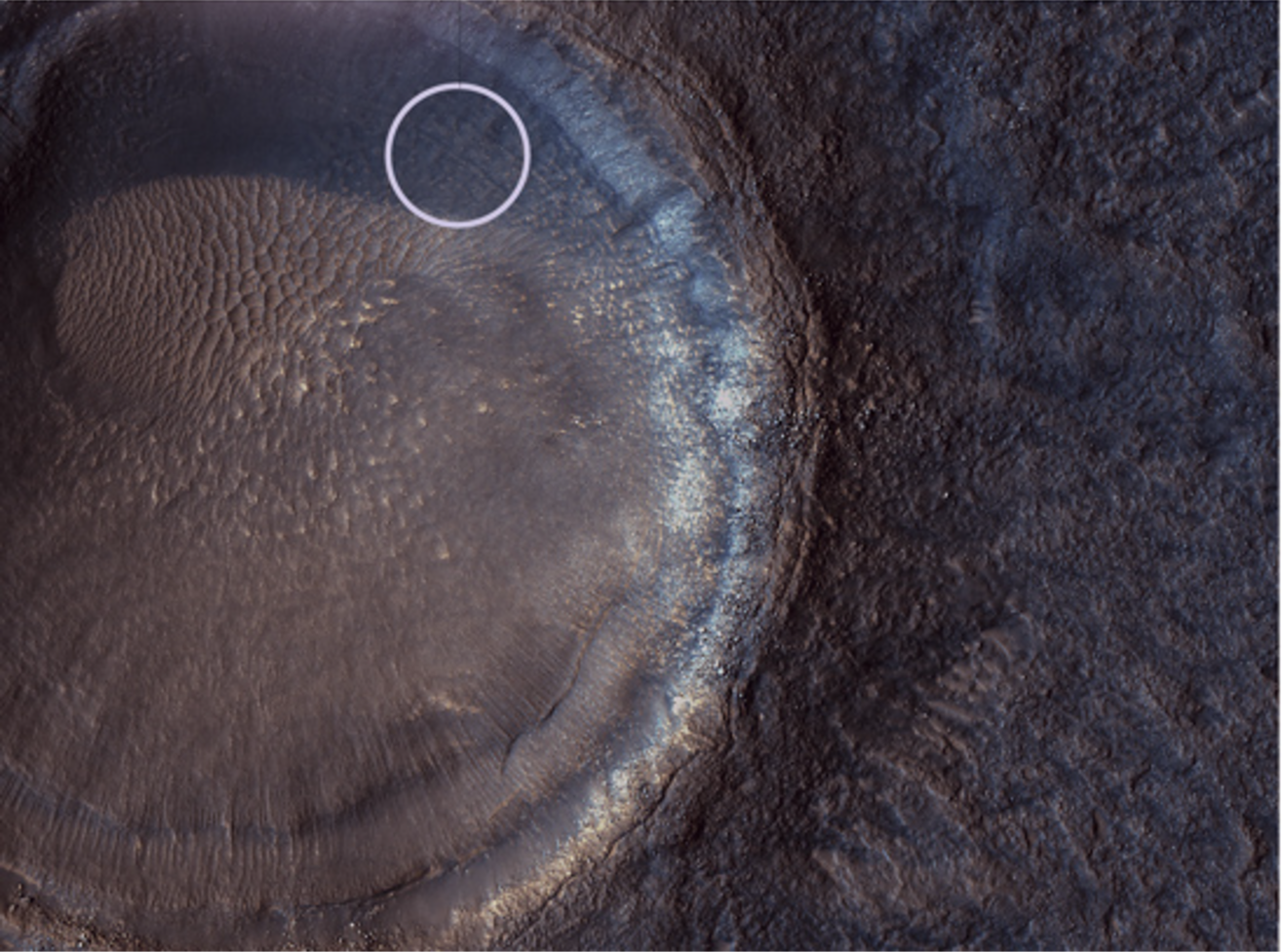
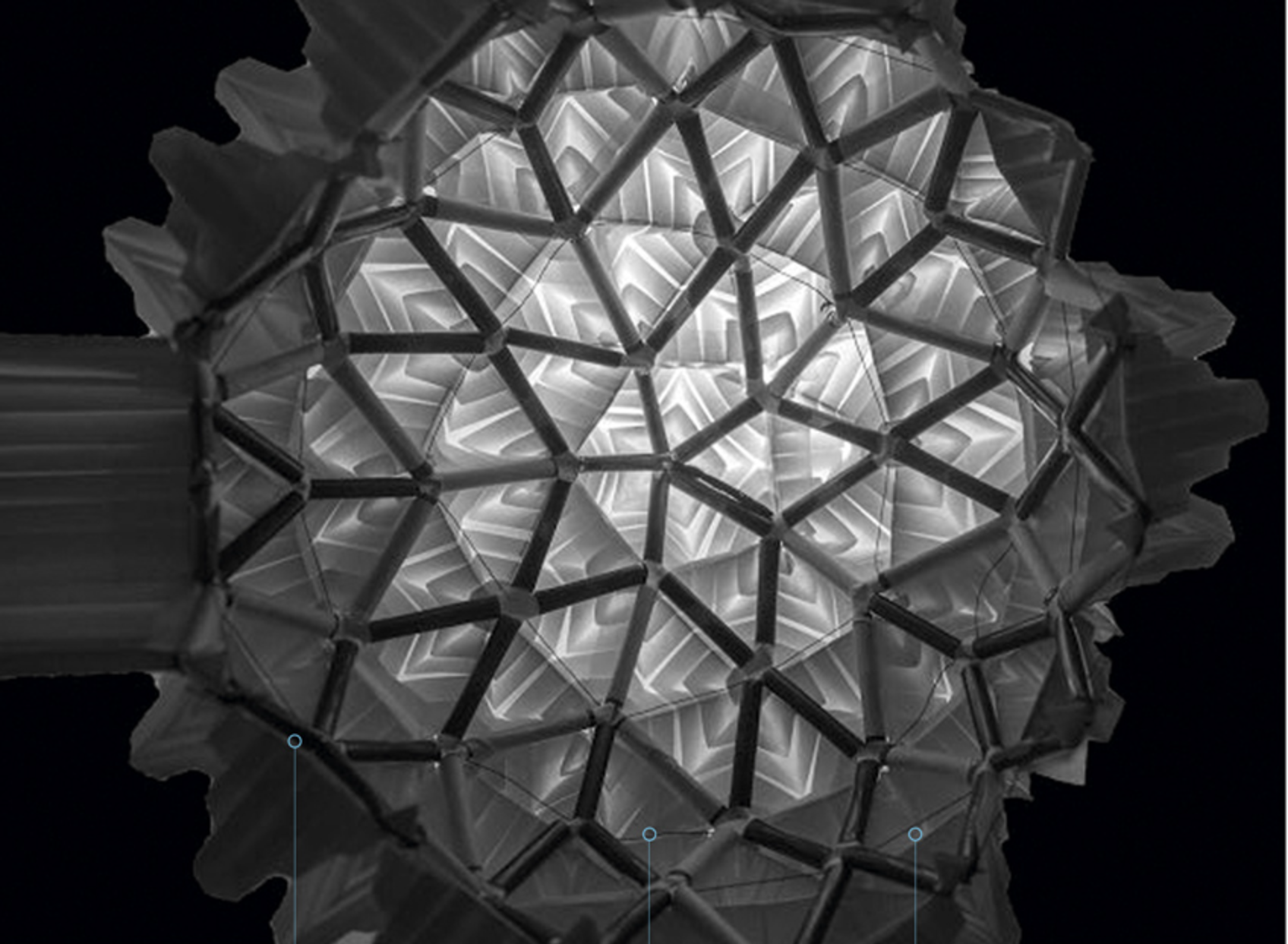
Variable size origami deployable geodesic dome
Overview
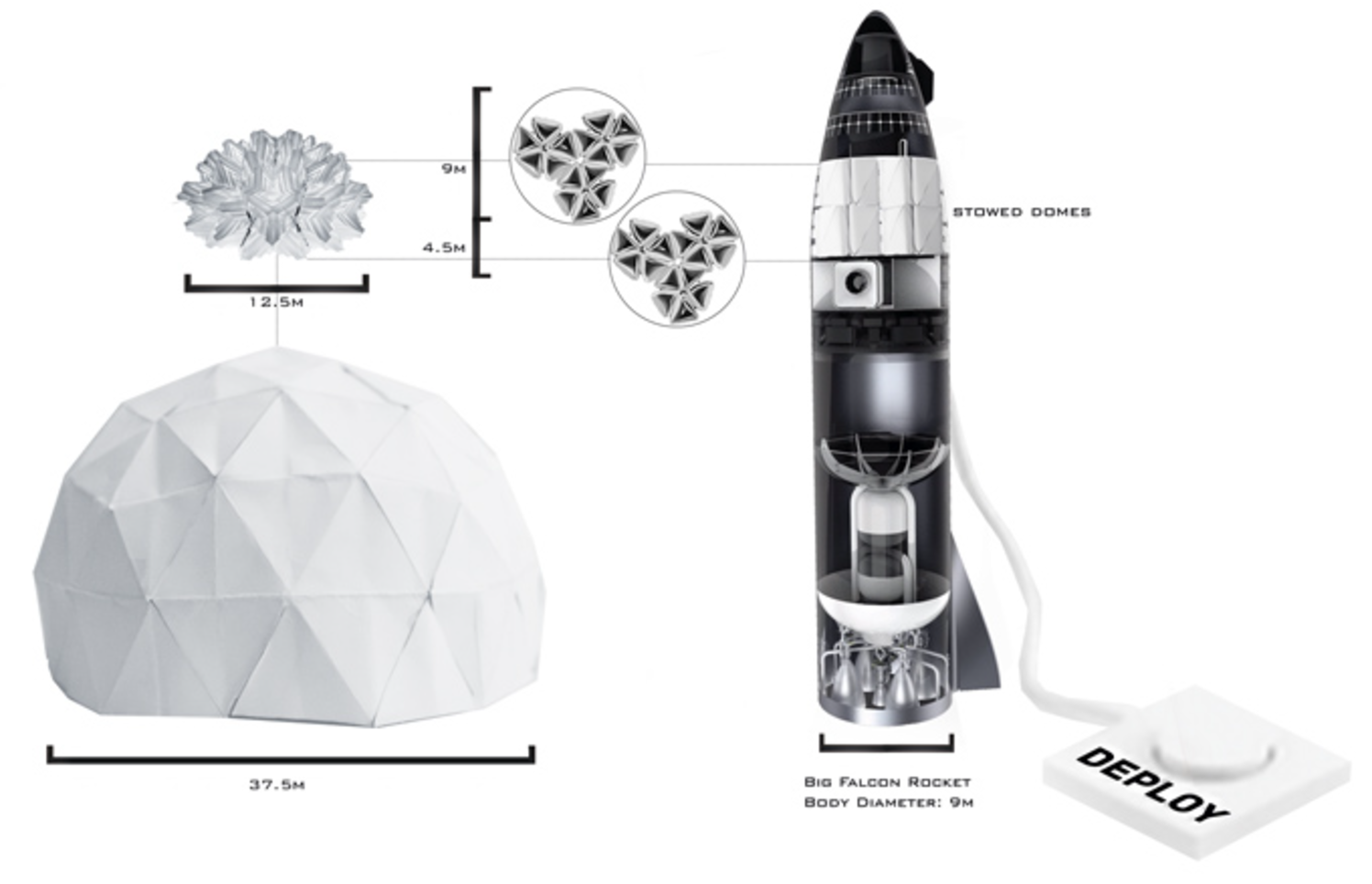
The habitat would be made of a geodesic dome with a tensegrity endoskeleton for bearing high loads that an inflatable alone couldn’t, while also being origami deployable from a small package and further expandable to many times its initial size, 27 times its initial habitable volume in this case.
Deployment
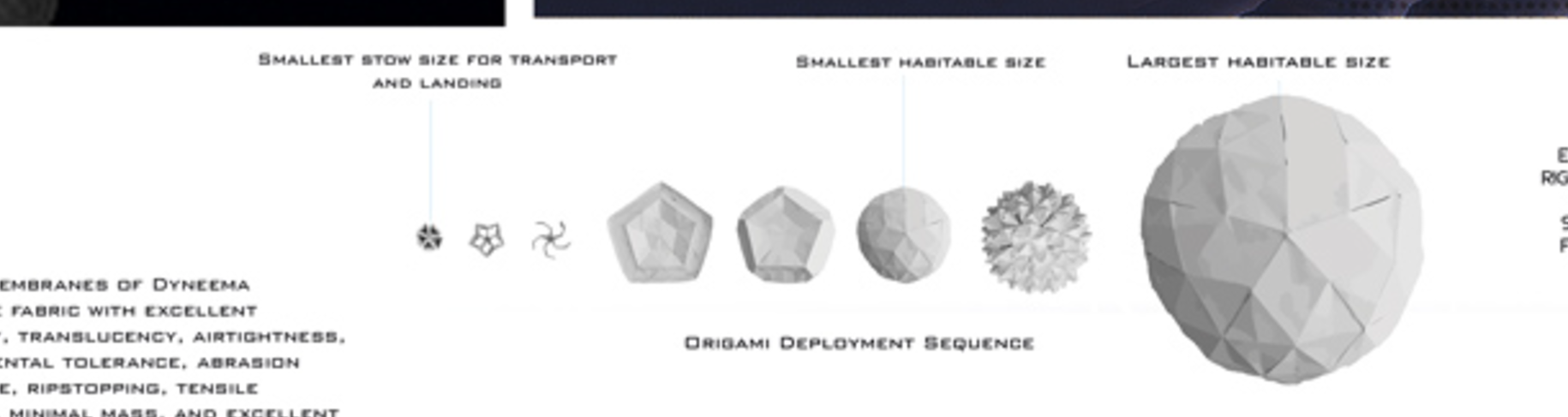
The dome in its most compact form will be origami stowed to a 5 m diameter and a 4 m height to fit inside the 5.22 m diameter by 13.1 m height of a Falcon 9 rocket fairing. After landing on the dune field inside a crater in the Deuteronilus Mensae region on Mars, it would auto-erect and unfold to a 3V geodesic dome with a diameter of 12.5 m.
The dome would then seal its doors, and the Mars Oxygen In-Situ Resource Utilization Equipment, MOXIE, would begin processing the carbon dioxide in the atmosphere into oxygen inside the dome to a pressure of 1 atm, that would slowly inflate the membrane into its habitable pollen mimicking shape.
The dome could then grow isotropically by extending its telescopic struts via an automated tendon actuating worm drive system. The origami folded membrane would then slowly unfold as the dome grows, until it reaches its maximum size with a diameter that is an integer multiple of its original, 3 in this case.
Geodesic tensegrity infrastructure
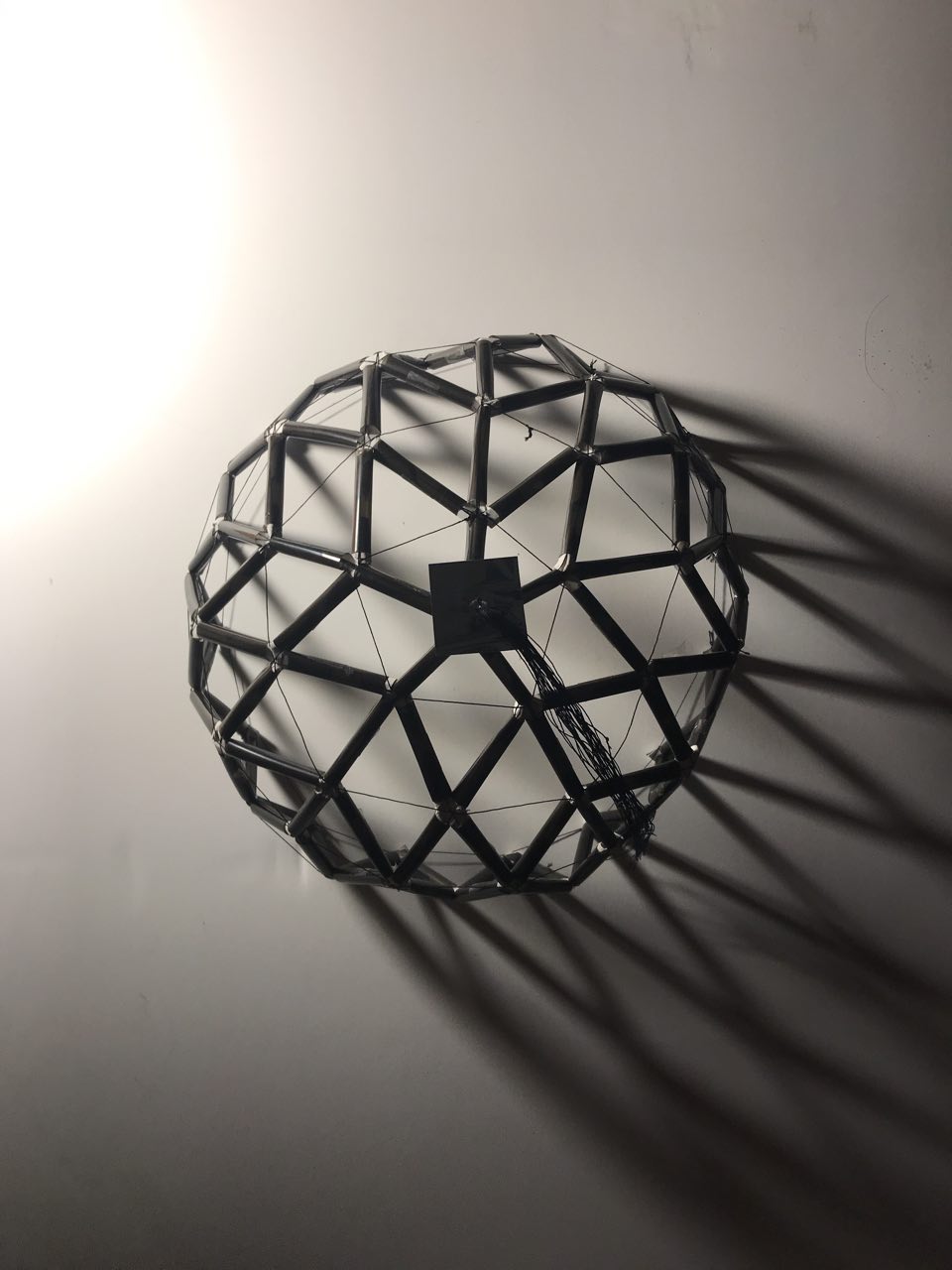
The infrastructure of the geodesic dome would be a tensegrity system whose components are all under compression or tension to maximize the strength of the structure while minimizing mass. The compressive members, struts, would be made of telescoping carbon fiber reinforced polymer tubes that can extend via tendon actuation.
In order to maximize tensile strength while maintaining high abrasion resistance, environmental tolerance, and minimal mass, the tensile members would be made of a cord of Zylon with an outer braiding of Ultra High Molecular Weight Polyethylene, UHMWPE. By making the tensile members out of flexible cords instead of heavier rigid members, the geodesic dome becomes deployable and origami stowable.
The auto-erection of the structure would take place as the tendon actuating worm drive draws the tensile members in, causing the struts to guide and lock into their hubs.
Inflatable origami membrane
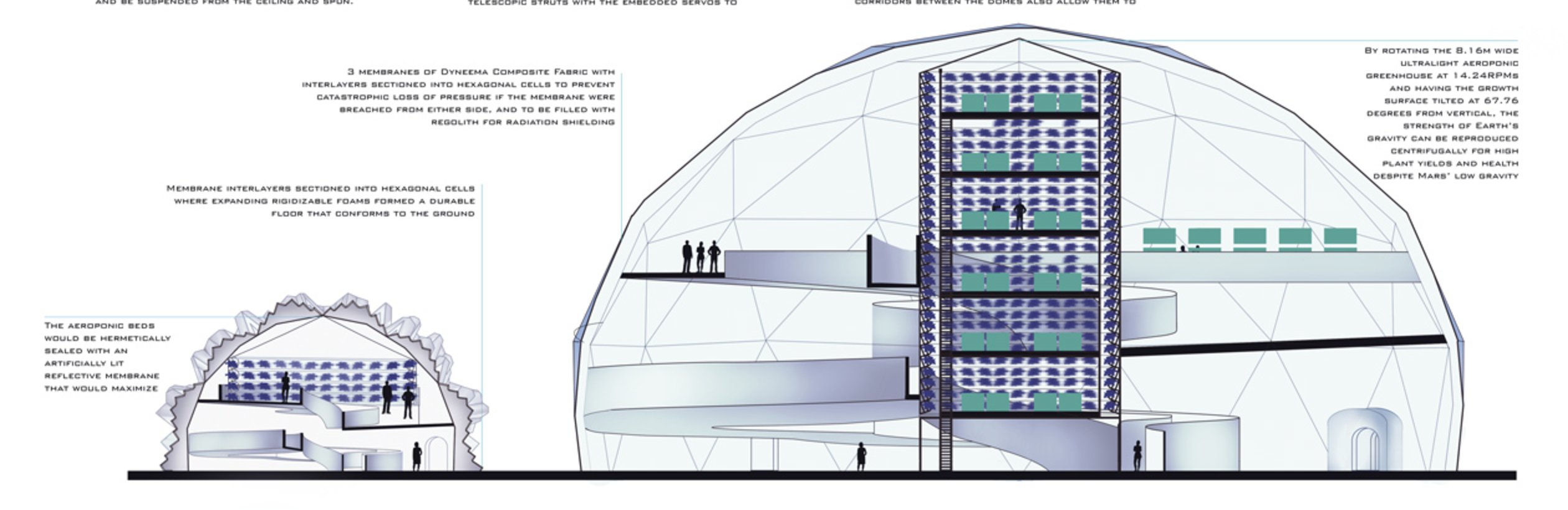
The origami inflatable membrane would have 3 layers for thermal insulation, extra radiation protection, and protection from physical hazards in the interior and exterior. Each interlayer space would be sectioned into hexagonal cells that would prevent a catastrophic loss of pressure in the event of a breach. These hexagonal cells could also be filled with Martian regolith for radiation shielding.
The inflatable membrane would be made of Dyneema composite fabric for its excellent flexibility, translucency, airtightness, Martian environmental tolerance, abrasion resistance, ripstopping, ultra-lightness, and excellent radiation absorbing properties due to its UHMWPE composition. The origami inflatable membrane would unfold and expand as the dome expands, until it is completely unfolded in the dome’s largest state.
The cells that make up the interlayer space of the floor membranes would have a self-expanding and rigidizing foam that would be activated after the dome self-erects, to create a durable floor that conforms to the terrain and provides thermal insulation.
Algae hydroponics and biopolymer printing
Algae hydroponic greenhouse
Algae is grown hydroponically with artificial lighting in tanks that also provide excellent radiation shielding for all who inhabit below. The algae recycle nutrients, produce oxygen, and sequester carbon dioxide captured from the Martian atmosphere into cellulose that can be processed into a 3D printable biopolymer or biopolymer film.
3D printing and biopolymer processing lab
The algae grown can be harvested and processed to extract its cellulose and recycle its remaining nutrients. The harvested cellulose can then be processed into a wide variety of biopolymers for the 3D printing of parts for the growing infrastructure as well as for repairs and maintenance. Since the infrastructure is fabricated through additive manufacturing it can benefit from the maximal strength and minimal mass of generative design.
Centrifugal aeroponic greenhouse at 1G
Overview
Plants are suspended aeroponically and planted in vertically stacked circular rows that are tilted and rotated centrifugally to reproduce the effects of Earth’s gravity on Mars. All plant rows are hermetically sealed with reflecting film and artificially lit to maximize their yield and health while minimizing moisture, nutrient, and energy losses.
1G permaculture on Mars
By spinning the beds centrifugally and tilting them perpendicular to the centripetal force, a force greater than Mars’ gravity can be exerted on the plants. On Mars, the beds must be tilted 67.76 degrees from vertical and rotating at a rate that is inversely proportional to its radius. In this case, a centrifugal greenhouse with beds tilted at 67.76 degrees, an 8.16 m diameter, and rotating at 14.24 RPMs will produce a sustainable acceleration of 1G on Mars and overcome the malignant effects of low gravity on the health and yields of plants.
Ultralight permaculture
By utilizing aeroponic growing techniques, an ultralight greenhouse can be suspended and spun to increase plant health and yield by reproducing the effects of Earth’s gravity on Mars. Utilizing aeroponics also uses 65% less water and 75% less nutrient input than hydroponics, which already has yields 280% higher than conventional soil agriculture. An aeroponic based system also helps prevent the spread of disease and pathogens that would otherwise spread through soil. Aeroponic plants also don’t experience the shock of being transplanted to soil like hydroponic plants do. NASA’s long history of innovation in aeroponics provides the technologic heritage.
Fabrication
The aeroponic support structure is assembled from interlocking units that are 3D printed from biopolymers and generatively designed to maximize strength and minimize mass. Since the biopolymers are derived from processed algae, their mass ultimately comes from the carbon dioxide captured from the Martian atmosphere by the algae.
When the origami deployable geodesic dome is expanded the ceiling rises and carries the centrifugal aeroponic greenhouse with it, making room for successive rings to be added to the bottom. When this dome is in its smallest size it initially fits 4 rings with a total of ~50 sqm of growing area, that is then expandable to 27 rings with a total of ~350 sqm of growing area when the dome is in its largest size.
Living quarters
The residence represents flexible structure depends on a deployable state of the dome. It is a ramp with minimum ramp slope is 5 degrees in a small deployable state and maximum is 12.5 degrees in an ultimate deployable state. Radiation shielding produces by algae tanks covering because of its translucent located to up level.
Residence area is a few cells, and each cell is a double room that can be turned into two single rooms by partition. Living quarters have enough spatial features for each habitant. For the eye pleasure and recreation, the base core arises as vertical farming being a point of attraction.
Equipment and transportation
External equipment on the site supports the habitat through its first seasons.
Colonization phases
Phase I. Small rigid habitats prefabricated on Earth, built into radiation shielding, for stays of a few weeks with food, water and air brought as supplies.
Phase II. Large deployable habitats like Desert Snowflake, prefabricated with high-performance materials and shielded with local regolith. They form networks, extend stays to months, and begin aeroponic agriculture, water extraction, oxygen generation and biopolymer production.
Phase III. The first truly Martian architecture: large bunker-style habitats built from processed local ore and high-performance polymers, and the first underground habitats. A Martian vernacular follows, optimized for low gravity, weak sunlight, cold and dust.
Specifications
Figures as presented on the competition boards and project documentation.